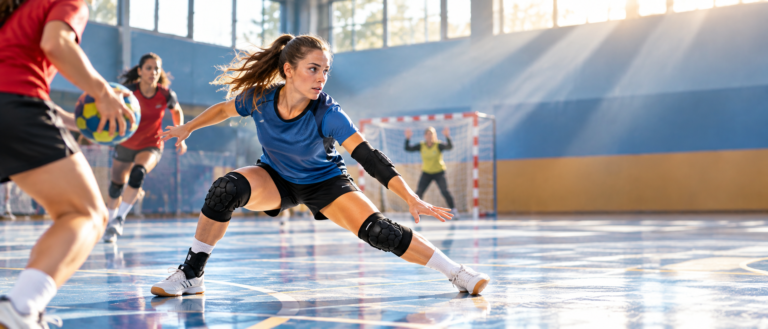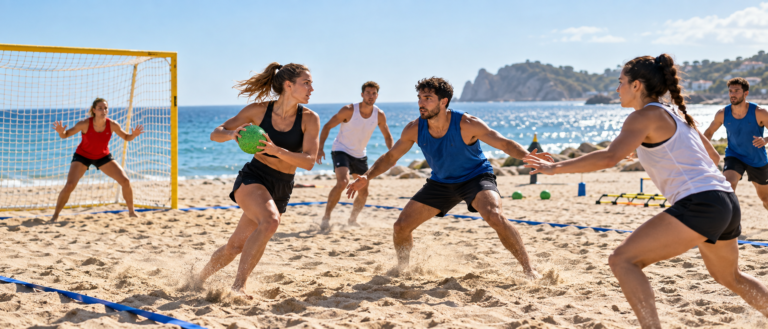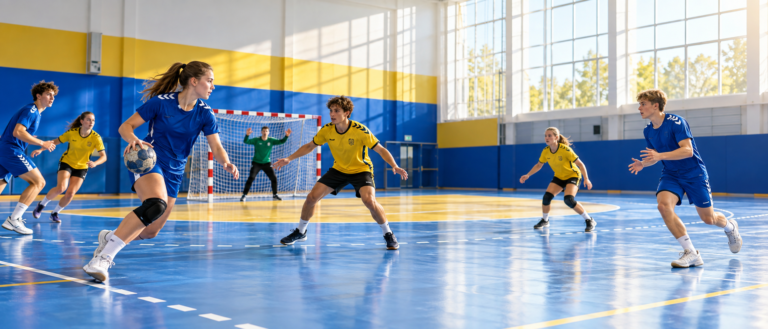
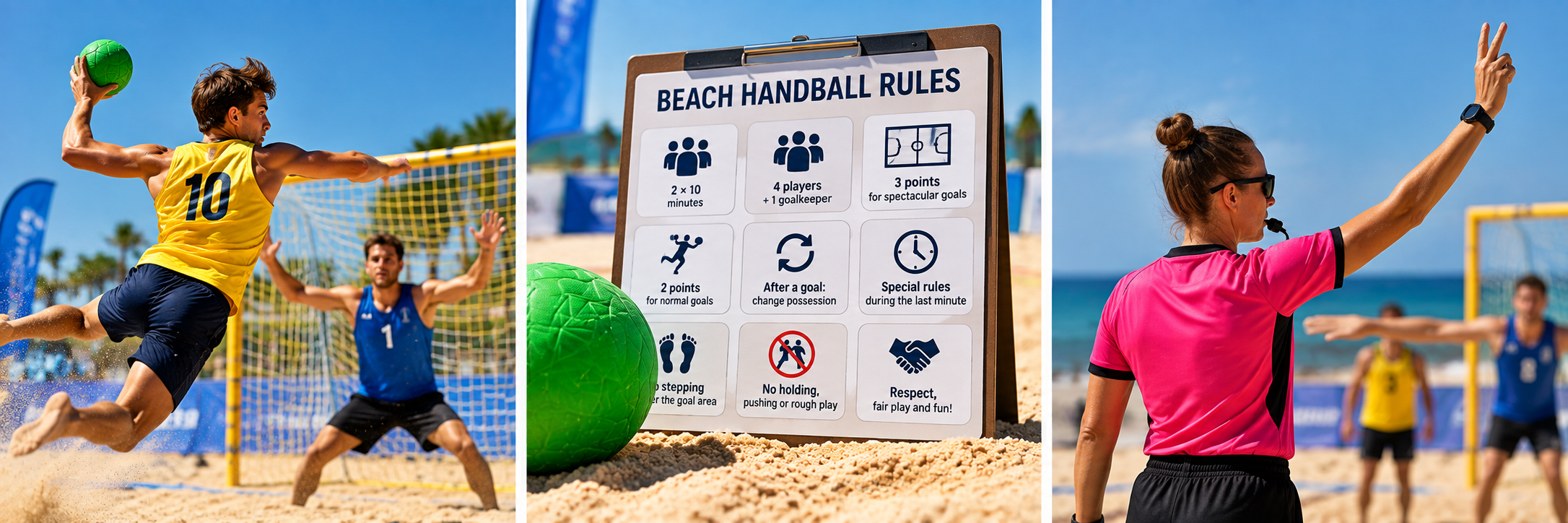
Beach handball is fast, acrobatic, and incredibly fun to play and watch. Whether you’re a coach, player, or beach sports fan, understanding the basic beach handball rules is essential. In this guide, we’ll break down the core elements: court size, team setup, and game duration, along with a few extra rules and tips to help you get started the right way.
Beach handball is governed internationally by the International Handball Federation (IHF), which sets the official rules for major tournaments. However, recreational and local leagues often adapt these rules slightly to fit their environment.
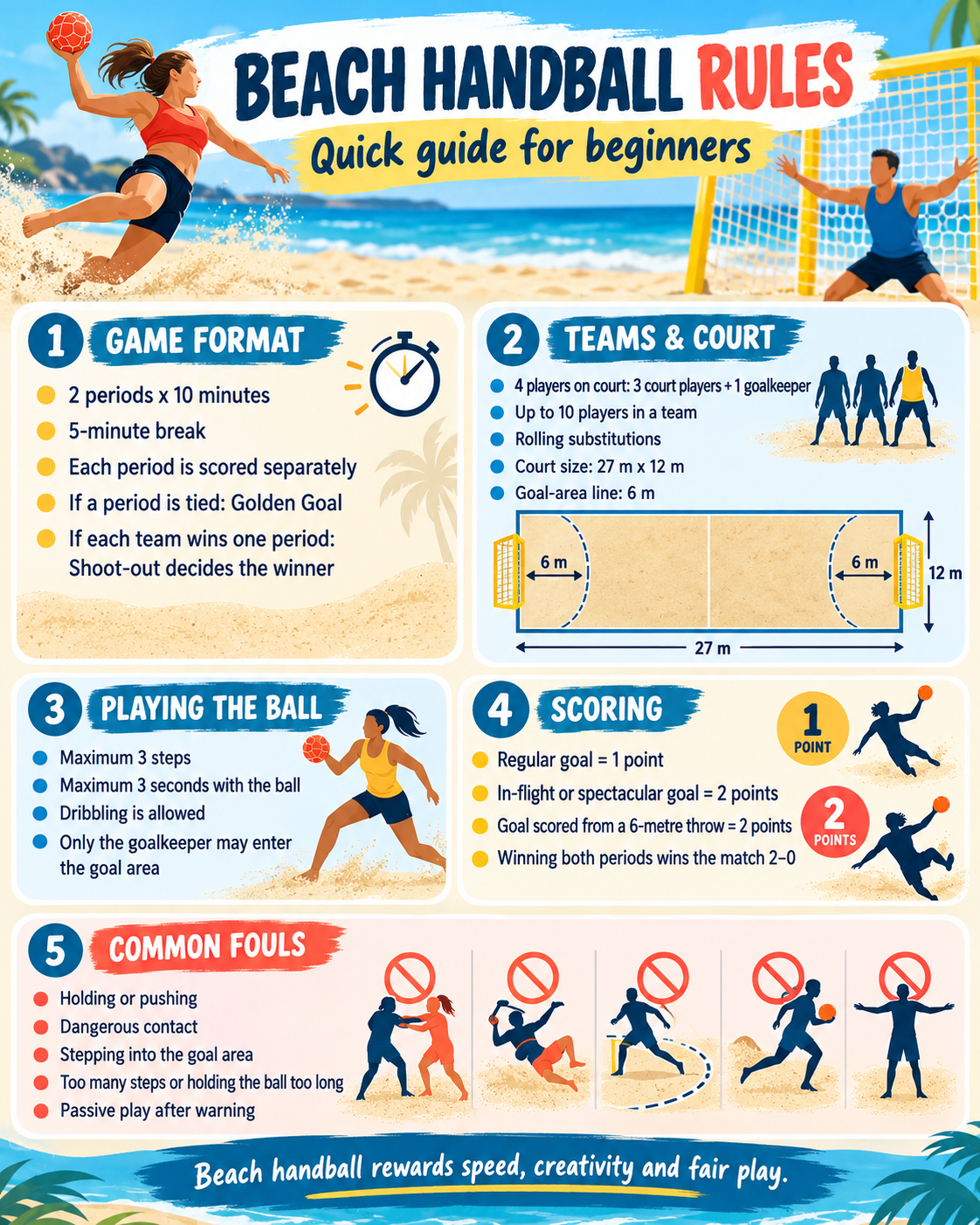
What Is Beach Handball?
Beach handball is a variation of indoor handball played on sand, usually outdoors on a beach. Teams score by throwing the ball into the opponent’s goal, but the sport is unique because of its spectacular athletic moves and special scoring system.
Key characteristics of beach handball:
- Played on sand, barefoot
- Smaller court and goals compared to indoor handball
- Teams are 4 players on the sand (3 court players + 1 goalkeeper)
- Two halves called “periods”, with a possible shoot-out if tied
- Extra points for spectacular goals like spins and in-flight shots
Beach Handball Court Size and Layout
The beach handball court is rectangular and designed to fit on a standard stretch of beach. Understanding the measurements and zones is the first step to setting up a proper game.
Official Beach Handball Court Dimensions
According to IHF guidelines, the standard beach handball court size is:
- Length: 25-27 meters
- Width: 12-14 meters
- Sand depth: At least 40 cm of soft, clean sand (for player safety)
For official competitions, the usual standardized size is:
| Element | Measurement |
|---|---|
| Court Length | 27 m |
| Court Width | 12 m |
| Goal Area Depth | 6 m from goal line |
| Goal Width x Height | 3 m x 2 m |
Court Zones and Lines
The beach handball court is divided into three main zones:
- Two Goal Areas: Located at each end of the court.
- One Central Playing Area: Where most of the action happens.
- Substitution Areas: On the sidelines, for player changes.
Goal Area
The goal area (also called the “D-zone”) is a 6-meter deep zone in front of each goal. Only the goalkeeper is allowed to stand inside the goal area. Field players may jump into it, but they must release the ball before they land.
- Goal area line: 6 meters from the goal line.
- Stepping into the goal area with the ball = free throw for the opposing team.
Substitution and Safety
On each sideline, near the center, there is a substitution area. Beach handball uses “flying substitutions,” meaning players can swap in and out at almost any time, as long as they follow the substitution rules and use the correct area.
Team Setup: Players, Positions, and Substitutions
Understanding beach handball team setup is crucial to organizing games and training sessions. The format encourages quick transitions, creative tactics, and strategic use of specialists like “flyers” and “specialists.”
Number of Players
In official beach handball matches:
- On the sand: 4 players per team
- 3 court players
- 1 goalkeeper (or specialist)
- Total squad: Up to 8 players (4 on the sand, 4 substitutes)
For recreational games, you can modify this slightly (e.g., 3 vs 3 or 5 vs 5) as long as the court size and rules remain clear to all participants.
Player Roles in Beach Handball
Though positions are more fluid than in indoor handball, teams still use basic roles:
- Goalkeeper: Defends the goal; can also play as an attacking goalkeeper and score goals worth 2 points.
- Specialist: A player wearing a different colored shirt; goals scored by the specialist also count as 2 points.
- Wings / Flyers: Usually the most acrobatic players, responsible for spin shots and in-flight goals.
- Universal Players: Adaptable players who defend, build the attack, and support fast breaks.
| Role | Key Strength | Bonus |
|---|---|---|
| Goalkeeper | Reflexes & positioning | 2-point goals when attacking |
| Specialist | Shooting accuracy | 2-point goals |
| Flyer | Jumping & spins | 2-point spectacular goals |
| Defender | Blocks & reading play | Starts fast breaks |
Substitution Rules
Beach handball uses unlimited substitutions. This keeps the game fast and intense, as teams constantly switch between attack and defense specialists.
Basic substitution rules:
- Players must enter and leave through their designated substitution area.
- The player leaving must be fully off the sand before the substitute steps in.
- Incorrect substitution can result in a 2-minute suspension or free throw for the opponent.
Game Duration: Periods, Overtime, and Shoot-Outs
The duration of a beach handball game is one of the easiest rules to understand, but it has a unique twist: games are played in two separate periods and often decided by a spectacular shoot-out if each team wins one period.
Standard Match Duration
According to IHF rules:
- A beach handball match consists of two periods.
- Each period lasts 10 minutes (playing time).
- There is a short break (about 5 minutes) between the two periods.
Winning Periods and Points
Unlike many sports, you don’t “add up goals” across an entire match to find the winner. Instead:
- Each 10-minute period is like a mini game.
- The team with more goals at the end of a period wins that period.
- Winning a period earns the team 1 match point.
- If the same team wins both periods (2-0), they win the match.
- If each team wins one period (1-1), the match goes to a shoot-out.
Shoot-Out Rules (Tie-Breaker)
A beach handball shoot-out is one of the most exciting parts of the game. It’s not like a normal penalty shoot-out in soccer-it’s more like a 1-on-1 fast-break duel.
Basic shoot-out structure:
- Each team takes turns: one attacker vs the goalkeeper.
- The shooter starts from their own goal line and receives a pass from the goalkeeper.
- They sprint towards the opposite goal and have one chance to score.
- Teams typically take five attempts each; if still tied, it goes to sudden death.
- Spectacular goals (spins, in-flight shots) and goals by the goalkeeper or specialist still count as 2 points.
Scoring System: How Many Points Is a Goal Worth?
One of the most exciting beach handball rules is the 2-point scoring system. Not all goals are equal-some are worth double.
1-Point Goals
- Standard field goal without spin or special jump.
- Goal scored by a regular player from a regular shot.
2-Point Goals
These special goals keep the game dynamic and reward creativity:
- In-flight goals: Player catches the ball while airborne and scores before landing.
- 360° spin shots: Player spins fully in the air and scores.
- Goals scored by the goalkeeper when they are in attack.
- Goals scored by the specialist wearing a different colored shirt.
Because of these rules, teams often try to set up spectacular moves instead of simple throws, making beach handball extremely entertaining.
Essential Beach Handball Rules Beyond the Basics
To fully understand beach handball rules basics, you should also know a few general regulations that affect gameplay.
Ball Handling
- A player can hold the ball for up to 3 seconds.
- A player can take up to 3 steps while holding the ball.
- Dribbling is allowed, but continuous dribbling like in basketball is rare on sand.
Defense and Fouls
- Body contact is allowed, but grabbing, hitting, or dangerous play is forbidden.
- Minor fouls usually result in a free throw for the opponent.
- More serious fouls may result in a 2-minute suspension or, in extreme cases, a red card (disqualification).
Throw-Off and Resuming Play
- Games start with a throw-off from the center of the court.
- After a goal, the goalkeeper quickly restarts the game, often with a long pass.
- This quick restart keeps the game flowing and encourages fast counterattacks.
Benefits of Playing Beach Handball
Beyond the rules and court size, it’s worth mentioning why so many players and clubs are turning to beach handball.
- Full-body workout: Running and jumping on sand builds strength, stability, and endurance.
- Low-impact surface: Sand is softer than indoor courts, reducing impact on joints.
- Improved coordination: Complex moves like spins and in-flight shots develop balance and agility.
- Team spirit and social aspect: Most games are played in a fun, relaxed beach environment.
- Great for youth development: Helps young players learn handball skills in a playful way.
Practical Tips for Setting Up a Beach Handball Game
If you want to start playing or organizing games, here are a few practical suggestions based on the official beach handball rules.
1. Marking the Beach Handball Court
- Use flat boundary lines (ropes or straps) that sit on the sand.
- Aim for the official dimensions: 27m x 12m if space allows.
- Clearly mark the 6-meter goal area line using rope or colored cones.
2. Choosing the Right Ball
- Beach handball balls are rubberized and non-slip.
- Size varies by age and gender, but in general:
- Men: Size 3
- Women: Size 2
- Youth: Size 1 or 2 (depending on age)
3. Safety and Comfort
- Check the sand for sharp objects before playing.
- Keep water and shade nearby, especially on hot days.
- Encourage warm-ups to prevent muscle injuries.
4. Adapting Rules for Beginners
When introducing beach handball to new players or kids, you can simplify:
- Use a smaller court or fewer players.
- Focus on basic throws and catches before introducing spin shots.
- Ignore 2-point goals initially, then add them later for more excitement.
Sample Recreational Beach Handball Setup
For a friendly or training match, you can use this simple structure:
| Element | Recommendation |
|---|---|
| Court Size | 20-25 m x 10-12 m |
| Team Size | 4 vs 4 (plus 2-4 subs) |
| Period Length | 2 x 8-10 minutes |
| Tie-Breaker | Short 3-shot shoot-out |
| Scoring | Allow 2-point goals for spins/flyers |
Conclusion: Master the Basics and Enjoy the Game
Beach handball combines the intensity of handball with the fun of a day at the beach. By understanding the basic rules of beach handball–court size, team setup, and game duration-you can set up safe, fair, and exciting matches for players of all levels.
To recap:
- The standard court is about 27m x 12m, with a 6m goal area and 3m x 2m goals.
- Teams play with 4 players on the sand (3 court players + 1 goalkeeper), plus substitutes.
- Matches are played in two 10-minute periods. Each period is scored separately, and a tied match is decided with a spectacular shoot-out.
- The unique 2-point scoring system rewards creativity and acrobatic moves.
Once you’ve mastered these beach handball rules basics, all that’s left is to grab a ball, mark a court on the sand, and start playing. The more you play, the more you’ll appreciate the strategy, speed, and spectacular goals that make beach handball one of the most exciting beach sports in the world.