Mini handball is one of the best ways to introduce children to handball in a fun, safe, and development-focused environment. Instead of focusing on tactics and winning at all costs, mini handball drills prioritize simple skills, lots of movement, and playful competition. When children learn through games, they not only develop their technical abilities faster, they also build confidence, teamwork, and a love for the sport that can last a lifetime.
In this guide, you’ll discover the best drills for mini handball that help young players learn essential skills through fun games. Whether you’re a coach, PE teacher, or parent, you’ll find ready-to-use ideas and practical tips to make your sessions dynamic, engaging, and age-appropriate.
What Is Mini Handball and Why Is It So Effective?
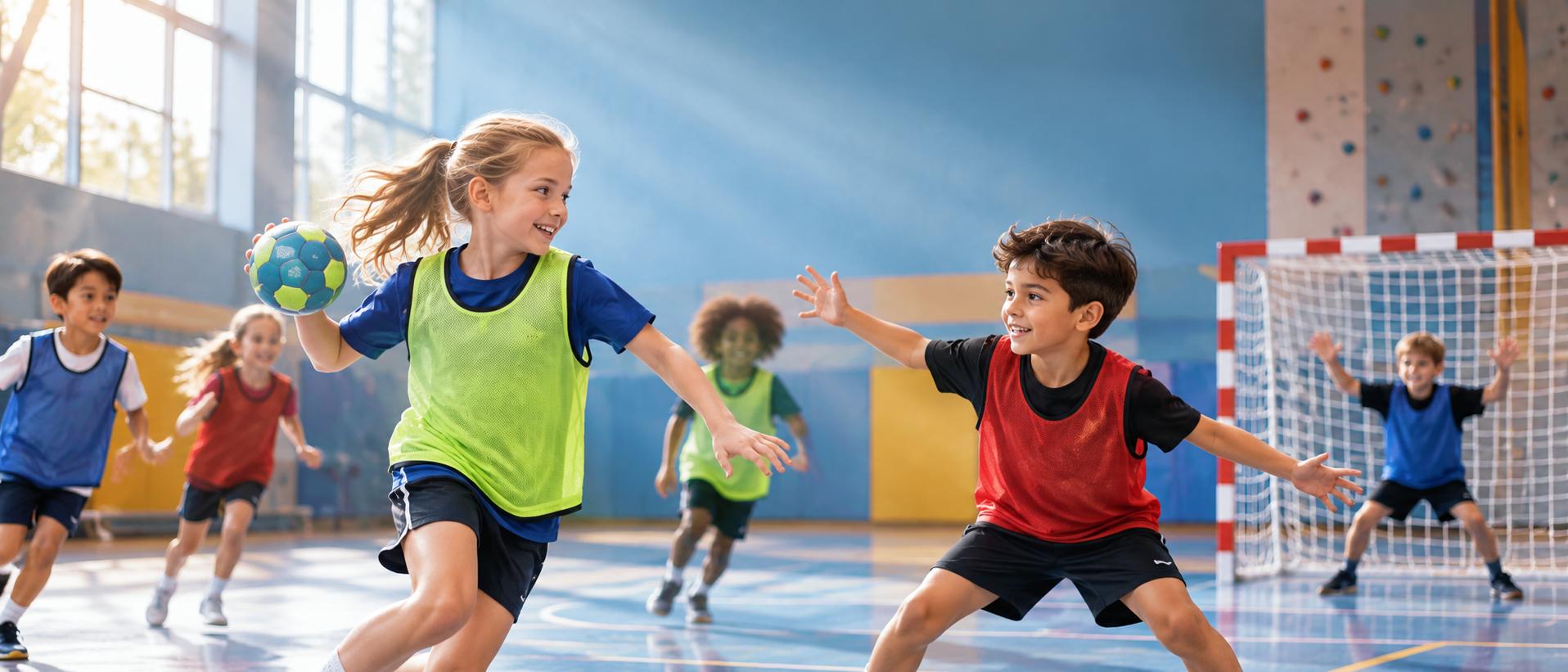
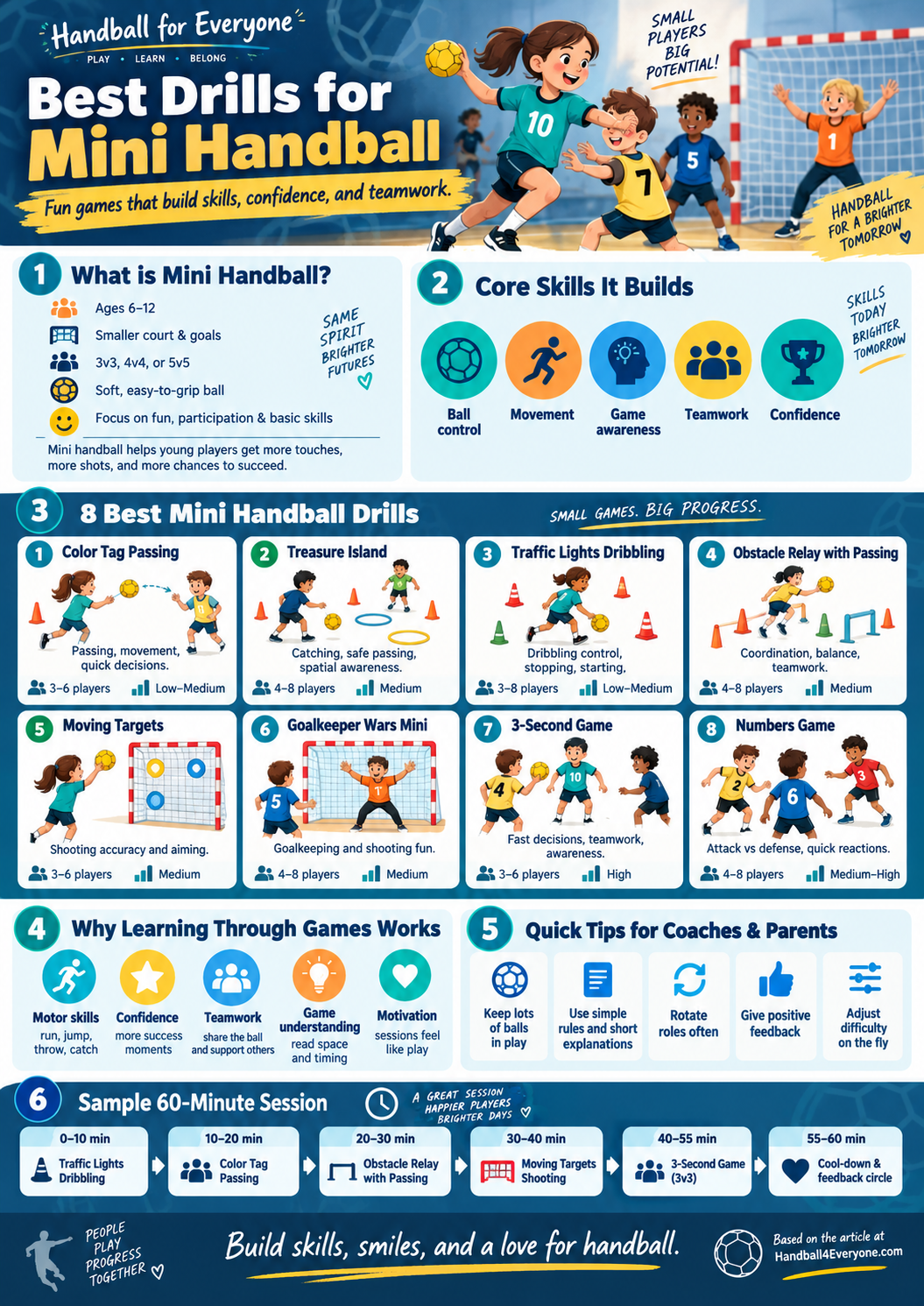
Mini handball is a simplified version of traditional handball, adapted to younger players (typically ages 6-12). The court is smaller, the ball is lighter and softer, and the rules are more flexible. The main goal is to learn handball skills through play, not through rigid drills or complex tactics.
Main characteristics of mini handball
- Smaller court and goals
- Reduced number of players (often 3v3, 4v4 or 5v5)
- Soft, small-sized ball for easy gripping
- Emphasis on fun, participation, and basic skills
- Short games and frequent rotations
Because everything is scaled down, young players get more ball contacts, more shots, and more chances to succeed. This is why learning through fun mini handball games is so effective for developing skills like passing, catching, and shooting.
Core Skills in Mini Handball
Before you choose drills, it helps to know the key skills you want to build. The best mini handball drills focus on these core areas:
- Ball control: catching, throwing, and basic dribbling
- Movement: running, stopping, changing direction, and jumping
- Game awareness: finding space, supporting teammates, and reading the play
- Teamwork: passing, communicating, and trusting others
- Confidence: taking shots, trying new moves, and making decisions
Each of the mini handball games below is designed to develop several of these skills at once, without feeling like “hard work” to the children.
Best Drills for Mini Handball: Fun Games by Skill Focus
The following drills are grouped by main skill focus, but most of them train multiple abilities at the same time. You can easily adapt them to different ages and group sizes.
| Drill Name | Main Skill | Players | Intensity |
|---|---|---|---|
| Color Tag Passing | Passing & Movement | 8-20 | Medium |
| Treasure Island | Catching & Decision-Making | 6-16 | Low-Medium |
| Moving Targets | Shooting Accuracy | 6-14 | Medium |
| 3-Second Game | Game Awareness | 8-14 | High |
| Goalie Wars Mini | Goalkeeping & Shooting | 2-6 | Medium-High |
Passing & Catching Drills for Mini Handball
1. Color Tag Passing
Objective: Improve passing accuracy, quick decisions, and movement off the ball.
Setup:
- Mark a playing area (half court or smaller).
- Divide players into 3-4 small teams with different colored bibs (e.g., red, blue, green).
- Use one mini handball.
How to play:
- Teams mix freely inside the area.
- Coach calls out a color (e.g., “Red!”). Only players wearing that color are allowed to pass the ball to each other.
- All other players run, dodge, and try to get open, but may not touch the ball.
- After 20-30 seconds, call a different color. The ball must then be passed only among that team.
Coaching tips:
- Encourage players to show their hands and call for the ball.
- Reward quick, clean passes over long, risky throws.
Variations:
- Limit the number of passes (e.g., 5 passes = 1 point).
- Add basic defenders who try to intercept passes (no contact).
2. Treasure Island Passing Game
Objective: Develop catching, safe passing, and spatial awareness.
Setup:
- Mark a square or rectangular area.
- Place several cones or soft objects in the center (the “treasure”).
- Divide players into two teams on opposite sides.
How to play:
- Teams must pass the ball among teammates while moving toward the middle “island.”
- A player standing next to the treasure can pick one item up only after receiving a pass.
- That player then passes to a teammate and runs back to their side with the treasure.
- After a set time (3-5 minutes), count how many treasures each team collected.
Key coaching points:
- Encourage soft hands when catching – no hard throws at close range.
- Ask players to keep their heads up and look for free space.
Variation: Allow gentle interception of passes to make it more game-like.
Drills for Movement, Coordination & Agility
3. Traffic Lights Dribbling
Objective: Practice dribbling control and quick stopping/starting.
Setup:
- Each child has one ball.
- Use the width of the court or a marked area.
How to play:
- All players dribble freely inside the area.
- Coach calls out colors:
- Green: run and dribble quickly
- Yellow: slow dribble, small steps
- Red: stop and hold the ball
- Change colors often to keep children engaged.
Coaching tips:
- Focus on ball control, not speed.
- Remind players to keep the ball low and close to their body.
Variation: Add simple handball actions: on “Blue,” players must pass to a partner and move to a new space.
4. Obstacle Relay with Passing
Objective: Combine movement skills with passing under light fatigue.
Setup:
- Create 2-4 lanes with cones for simple obstacles (zigzag, mini jumps, side steps).
- Form teams of 3-5 players, one ball per team.
How to play:
- Player 1 runs the obstacle lane with the ball (dribbling or carrying).
- At the end, they pass to Player 2, who starts their run.
- Continue until everyone has gone 2-3 times.
Coaching tips:
- Encourage correct footwork and balance over speed.
- Give extra points for accurate passes at the end of each lane.
Variation: Require one catch-and-shoot at a mini goal or cone at the end of each run.
Shooting Games for Mini Handball
5. Moving Targets Shooting Game
Objective: Improve shooting accuracy in a playful environment.
Setup:
- Use a real goal or create a “goal” with cones.
- Hang or attach small targets (hoops, cones, bibs) to the goal or place them inside it.
- Players line up at different shooting distances.
How to play:
- Players take turns shooting at specific targets (e.g., “Top left cone”).
- Hit = 2 points, goal without hitting target = 1 point.
- First to reach a set number of points wins (e.g., 8-10 points).
Coaching tips:
- Focus on correct arm swing and follow-through.
- Encourage players to aim, not just throw hard.
Variation: Have 1-2 players move gently in front as “moving targets” wearing colored bibs-no blocking, just visual distraction.
6. Goalkeeper Wars Mini
Objective: Develop both shooting and basic goalkeeping skills.
Setup:
- Use two small goals face-to-face about 8-12 meters apart.
- One player in each goal with a small handball.
How to play:
- Goalkeepers take turns throwing the ball to score in the opposite goal.
- They must throw from inside their own goal area line.
- First to a set number of goals wins; then rotate players.
Coaching tips:
- Emphasize safe diving and basic positioning for the goalkeeper.
- Teach shooters to look where they want to throw, not at the ball.
Variation: Allow 1 field player in each “half” who can receive a pass and shoot, adding more game realism.
Game Awareness & Teamwork Drills
7. The 3-Second Game
Objective: Increase quick decision-making, passing speed, and teamwork.
Setup:
- Use a small court with mini goals or cones.
- Play 3v3 or 4v4.
How to play:
- Regular mini handball rules, but the player with the ball has only 3 seconds to pass or shoot.
- If they hold it longer, the ball goes to the other team.
- Play short games of 3-5 minutes with quick rotations.
Coaching tips:
- Encourage constant movement without the ball to offer passing options.
- Ask players to “think before they get the ball” – scan the court.
Variation: Start with 5 seconds and gradually reduce as players improve.
8. Numbers Game (Call & Play)
Objective: Teach transition from defense to attack and quick recognition of numerical advantage.
Setup:
- Players split into two equal teams, standing on opposite baselines.
- Each player gets a number (1-5 or 1-6 depending on team size).
- One ball placed in the center.
How to play:
- Coach calls out one or more numbers: “1 and 3!”
- Players with those numbers from each team run to the center; whoever gets the ball first attacks the near goal, the other defends.
- Play continues until a shot or turnover, then players return to their lines.
- Rotate through different combinations: 1v1, 2v1, 3v2, etc.
Coaching tips:
- Explain simple principles: use free player in attack, close space in defense.
- Keep rounds short to maintain high intensity and focus.
Variation: Award bonus points for a successful pass before shooting to reinforce teamwork.
Benefits of Learning Mini Handball Through Fun Games
Using fun drills for mini handball delivers much more than just technical skills. It supports children’s physical, mental, and social development.
| Benefit | How Games Help |
|---|---|
| Motor skills | Running, jumping, throwing & catching in every drill |
| Confidence | Lots of success moments, shots and ball touches |
| Teamwork | Sharing the ball, supporting teammates, celebrating |
| Game understanding | Reading space, timing passes, choosing when to shoot |
| Motivation | Sessions feel like play, not like “training” |
Because the focus is on learning through play, children are more engaged and more likely to stick with the sport over time.
Practical Tips for Coaches and Parents
1. Keep the Ratio of Balls to Players High
The more touches each child gets, the faster they improve. Aim for at least one ball for every 2-3 players in most mini handball drills.
2. Use Simple Rules and Short Explanations
Explain each game in 30-60 seconds, then demonstrate once. Children learn best by doing, not by listening to long speeches.
3. Rotate Roles Frequently
Allow everyone to try attacking, defending, and goalkeeping. Rotation keeps kids engaged and prevents “fixed positions” too early.
4. Focus on Positive Feedback
Highlight effort and good ideas, even when they fail. For example, “Nice try finding your teammate” or “Good movement into space.” This builds confidence and a growth mindset.
5. Adjust Difficulty on the Fly
- If players succeed too easily, add a defender or reduce allowed time with the ball.
- If they struggle, make the area bigger, remove defenders, or allow extra steps.
Sample 60-Minute Mini Handball Session Plan
Here’s a simple example of how to combine these mini handball drills into one engaging practice.
| Time | Activity | Focus |
|---|---|---|
| 0-10 min | Traffic Lights Dribbling | Warm-up, ball control |
| 10-20 min | Color Tag Passing | Passing & movement |
| 20-30 min | Obstacle Relay with Passing | Coordination & teamwork |
| 30-40 min | Moving Targets Shooting | Shooting accuracy |
| 40-55 min | 3-Second Game (3v3) | Game awareness & decisions |
| 55-60 min | Cool-down & feedback circle | Reflection & stretching |
Adjust the times based on age and number of players, but keep the rhythm fast, with minimal waiting lines and lots of ball contact.
Conclusion: Build Skills, Smiles, and a Love for Handball
The best drills for mini handball don’t look like traditional, rigid exercises. They look like games: colorful, noisy, and full of laughter. By designing sessions around fun mini handball games, you can teach children to pass, catch, shoot, and move intelligently on the court-without them ever feeling like they are “just training.”
Use the drills in this article as a toolkit: mix and match passing games, shooting challenges, and small-sided matches to keep every session fresh and exciting. Focus on inclusion, effort, and simple, clear goals. When young players associate handball with fun, friendship, and success, they are far more likely to stay in the sport, improve quickly, and eventually grow into confident, skilled handball players.
Start with one or two of these mini handball drills in your next practice, and watch how quickly your players learn, smile, and ask for “one more game!”