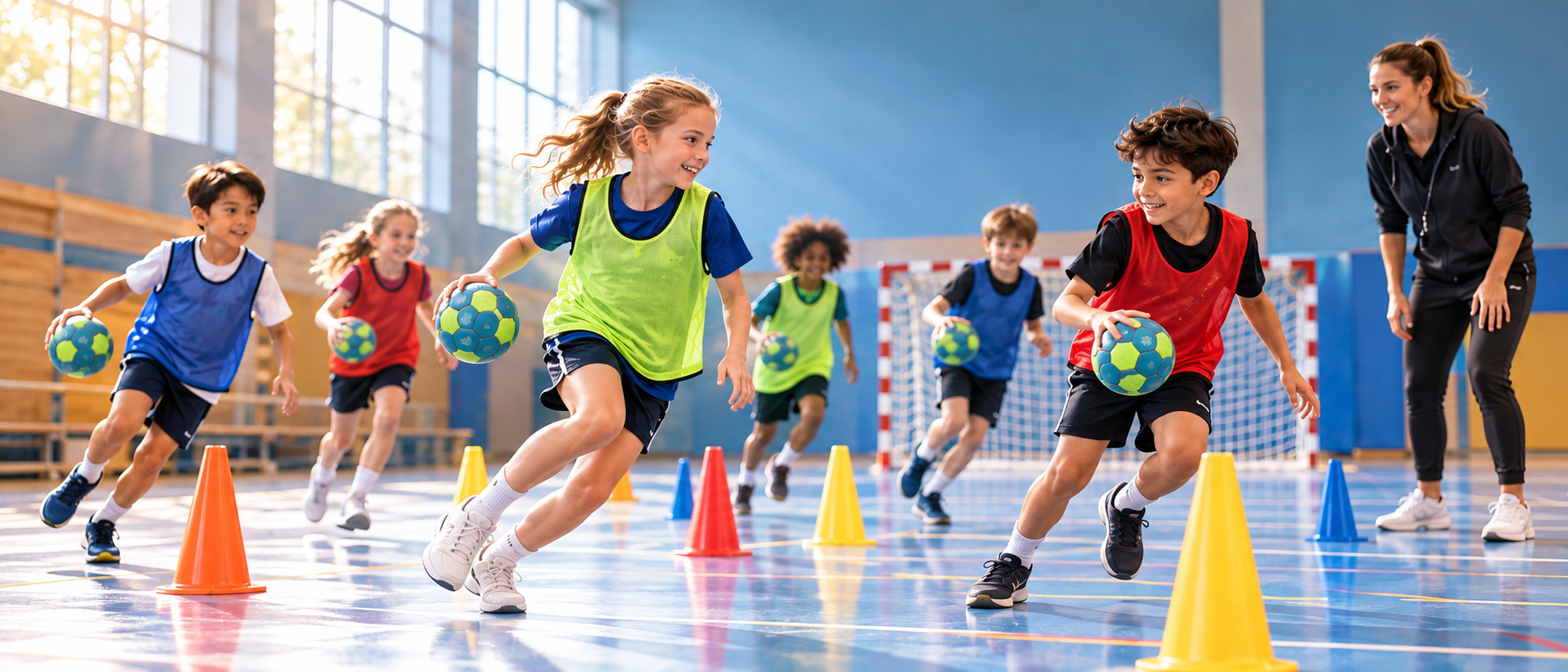
Mini handball is one of the best ways to introduce children to team sports. It’s fast, exciting, and easy to adapt for any age. When you focus on fun mini handball drills, kids not only improve their dribbling and passing skills, but they also build confidence, coordination, and a love for physical activity.
This guide walks you through engaging, kid-friendly handball drills you can use in PE classes, youth clubs, after-school programs, or community sports sessions. All exercises are designed to be simple, safe, and fun – perfect for beginners and younger players.
Why Mini Handball Drills Are Perfect for Kids
Mini handball is a modified version of handball played on a smaller court with smaller goals and softer balls. It’s designed specifically for children and beginners.
Main benefits for kids
- Improves coordination: Dribbling, catching, and passing build hand-eye and foot-eye coordination.
- Teaches teamwork: Kids quickly learn to communicate and cooperate with teammates.
- Builds confidence: Simple, achievable drills help shy players feel successful.
- Develops basic game sense: Children understand space, timing, and movement without complex rules.
- Great cardio workout: Short sprints, quick changes of direction, and constant movement keep kids active.
When the focus is on fun, kids are more likely to stay engaged, come back next session, and keep improving their mini handball skills.
Setting Up Fun Mini Handball Sessions
Before jumping into the drills, a little planning goes a long way in keeping children safe, active, and focused.
Equipment you’ll need
- Soft mini handballs (foam or lightweight rubber, size adapted to age)
- Cones or floor markers
- Mini handball goals or makeshift targets (mats, benches, taped squares on a wall)
- Bibs or pinnies for team games
- Whistle or simple start/stop signals
Ideal age groups and group sizes
| Age | Group Size | Focus |
|---|---|---|
| 5-7 years | 6-12 kids | Basic ball control & fun movement |
| 8-10 years | 8-16 kids | Simple passing & mini games |
| 11-12 years | 10-18 kids | Faster drills & tactical awareness |
Safety and space
- Check the floor for slippery spots or obstacles.
- Ensure space between groups to avoid collisions.
- Use soft balls for younger kids or indoor spaces.
- Keep drills short (2-4 minutes) with frequent breaks.
Fun Dribbling Drills for Mini Handball
Dribbling is the foundation of handball. Simple, playful dribbling drills for kids help them control the ball while moving and changing direction.
1. Traffic Lights Dribble
Goal: Improve basic dribbling control and reaction speed.
Setup:
- Each child has a ball and enough personal space.
- Coach or teacher stands where everyone can see/hear them.
How to play:
- Green light: Kids dribble forward, exploring the space.
- Yellow light: Slow dribble or dribble in place.
- Red light: Stop and hold the ball, maybe in a “statue pose.”
Call the colors in random order, gradually increasing speed. To keep it fun, add variations:
- Blue light: Turn around with three dribbles.
- Purple light: Sit on the ball or do a quick squat holding the ball.
2. Cone Maze Dribbling
Goal: Develop ball control while changing direction.
Setup:
- Place several cones randomly to create a “maze.”
- Each child starts at one end with a ball.
How to play:
- Players dribble through the maze without touching the cones.
- If they hit a cone, they quickly put it back and continue.
- Encourage different paths each time to avoid repetition.
Progressions:
- Time them: “How many cones can you pass in 30 seconds without touching one?”
- Ask for specific moves around cones (e.g., turn left, spin, stop-and-go).
3. Dribble, Freeze & Pose
Goal: Improve balance and ball control under playful pressure.
Setup: Entire group in an open space, each child with a ball.
How to play:
- Kids dribble in any direction.
- When the coach calls “Freeze!” (or blows a whistle), they must stop and hold a specific pose:
- “One foot only!”
- “Ball above your head!”
- “Ball between your knees!”
- Start dribbling again on the next signal.
Turn it into a mini handball challenge by rewarding creative poses or super-fast freezes.
Engaging Passing Drills for Kids
Passing builds teamwork and communication. These passing drills for mini handball focus on short, accurate passes and simple movement.
4. Partner Pass & Move
Goal: Learn basic passing, catching, and movement off the ball.
Setup:
- Pairs of children spaced out across the court.
- One ball per pair.
How to play:
- Players stand 2-3 meters apart.
- They pass the ball back and forth using two hands.
- After each pass, the passer takes two quick steps sideways or forward.
- Receiver adjusts position to stay facing their partner.
Progressions:
- Increase distance slightly as accuracy improves.
- Limit touches: “Catch and pass without holding the ball too long.”
- Ask for a specific type of pass: chest pass, bounce pass, overhead pass.
5. Passing Circle (Hot Potato)
Goal: Develop quick, accurate passing and attention.
Setup:
- Group forms a big circle (6-12 players).
- One or two balls in play.
How to play:
- Players pass the ball to the person next to them around the circle.
- After a few rounds, add a second ball going in the same or opposite direction.
- Tell them “The ball is hot – don’t hold it too long!” to encourage quick passing.
Variations:
- Reverse direction on a whistle.
- Call out a player’s name: the next pass must go to that person.
- Set a target: “Let’s see if we can make 20 passes without dropping.”
6. Passing Through the Gate
Goal: Improve passing accuracy and timing.
Setup:
- Create several “gates” with two cones each, about 1-1.5 m apart.
- Pairs of players stand on opposite sides of a gate, 3-4 m apart.
- One ball per pair.
How to play:
- Players pass the ball through the gate to each other.
- Count how many successful passes they can do in 30 seconds.
- Ask them to move slightly left or right after passing to adjust angles.
Progressions:
- Make gates narrower for a challenge.
- Use bounce passes only.
- Ask them to pass with their non-dominant hand (older kids).
Combination Drills: Dribbling and Passing Together
Once kids are comfortable with basic dribbles and passes, blend skills into simple mini handball combination drills. This builds real game feeling and prepares them for mini matches.
7. Dribble & Pass Relay
Goal: Combine dribbling, passing, and teamwork with a fun race.
Setup:
- Divide children into 3-4 small teams (3-5 players each).
- Line them up behind starting cones.
- Place a turning cone 8-12 m away.
- One ball per team.
How to play:
- First player dribbles to the turning cone and back.
- On the way back, they stop 2-3 m before the line and pass to the next teammate.
- Next player catches the ball and repeats.
- Continue until everyone has had a turn.
Tips:
- Reward teams for control and fair play, not just speed.
- Ask teams to cheer for each runner to build a positive atmosphere.
8. 3-Player Passing Triangle
Goal: Introduce movement to space, passing angles, and basic positioning.
Setup:
- Groups of three form a triangle (about 3-5 m between players).
- One ball per group.
How to play:
- Player A passes to B and then runs to swap positions with C.
- Player B passes to C and then runs to swap with A.
- Continue this pattern, always passing then moving.
Progressions:
- Set a time challenge: “How many passes in 1 minute?”
- Ask them to call the name of the player they are passing to.
- Older kids can add one defender inside the triangle trying to intercept.
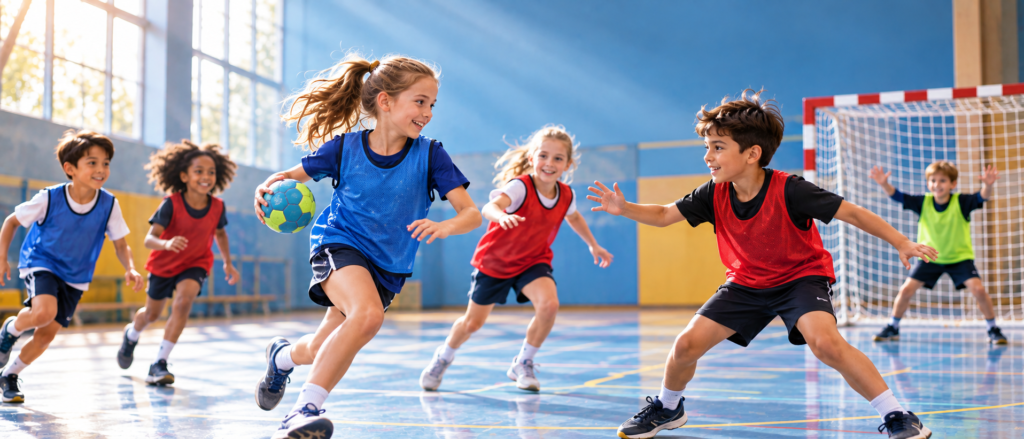
9. Mini 3v3 Handball Games
Goal: Apply dribbling, passing, and basic decision making in game situations.
Setup:
- Small court with mini goals or targets.
- Teams of 3-4 players each.
- Soft, age-appropriate ball.
Simple rules for kids:
- No hard contact or pushing.
- Encourage 3 steps max with the ball (adjust by age).
- Promote passing over solo play: bonus point for goals after 3 passes.
- Use short games of 3-5 minutes, then rotate teams.
Mini matches are the most exciting part of fun mini handball training, and they help children connect skills with real play.
Sample Mini Handball Session Plan (60 Minutes)
| Time | Activity | Focus |
|---|---|---|
| 0-10 min | Warm-up games (tag, running & movement) | Fun, mobility, activation |
| 10-20 min | Traffic Lights Dribble | Basic dribbling control |
| 20-30 min | Partner Pass & Move | Short passes, catching |
| 30-40 min | Dribble & Pass Relay | Combining skills & teamwork |
| 40-55 min | 3v3 mini handball games | Game sense, decision-making |
| 55-60 min | Cool-down & quick feedback | Stretching, reflection |
Practical Tips for Coaches, Teachers, and Parents
Keep mini handball fun and inclusive
- Rotate roles: Let every child try different positions, including goalkeeper.
- Celebrate effort: Praise good passes, smart ideas, and teamwork, not just goals.
- Give simple instructions: Use clear, short cues: “Eyes up,” “Two hands,” “Find a friend.”
- Avoid long speeches: Explain drills in 30-60 seconds, then let them learn by doing.
Adapt drills to different skill levels
- For beginners, make distances shorter and reduce pressure.
- For more advanced kids, add defenders, time limits, or goals.
- Always have a “challenge version” ready for kids who master the basics quickly.
Use positive coaching language
- Instead of “Don’t drop the ball,” say “Hands ready to catch.”
- Instead of “Stop running alone,” say “Look for a teammate to pass to.”
- Ask questions: “What could you do differently next time?”
Real-Life Example: Mini Handball in a Primary School
In a mixed Year 3-4 class (ages 7-9), a teacher introduced a six-week mini handball unit using the drills above. Sessions were held once per week during PE.
Week 1-2:
- Traffic Lights Dribble and Cone Maze for coordination.
- Simple partner passes with very short distances.
Week 3-4:
- Dribble & Pass Relays to build speed and excitement.
- Triangle passing for small group cooperation.
Week 5-6:
- Mini 3v3 games with modified rules (must pass at least twice before shooting).
- Focus on friendly competition and supporting teammates.
By the end, even initially hesitant students were dribbling confidently, calling for passes, and celebrating each other’s success. The teacher reported better class cohesion, improved listening skills, and greater enthusiasm for PE overall.
Conclusion: Build Skills Through Fun Mini Handball Drills
Fun, age-appropriate mini handball drills are a powerful way to develop dribbling and passing skills for kids while keeping them active and happy. By mixing simple ball control exercises with cooperative passing games and short mini matches, you can create sessions that are both educational and exciting.
Whether you’re a PE teacher, youth coach, or parent planning a sports activity, start with:
- Basic dribbling games like Traffic Lights and Cone Maze.
- Simple partner and group passing drills.
- Combination activities and 3v3 mini handball games.
Keep drills short, instructions clear, and the focus on fun and teamwork. Over time, you’ll see children grow in confidence, coordination, and game understanding – and most importantly, they’ll discover how enjoyable mini handball can be.