Mini handball is a fun, fast, and kid-friendly version of traditional handball. It’s designed to introduce children to the sport in a safe, simple, and playful way. If you’re a parent, coach, or PE teacher looking for an easy guide to mini handball rules, this article breaks everything down for you: court size, team structure, basic gameplay, and practical tips for teaching kids.
Below you’ll find a complete, SEO-optimized guide to mini handball for kids that you can use to run training sessions, school lessons, or after-school activities.
What Is Mini Handball?
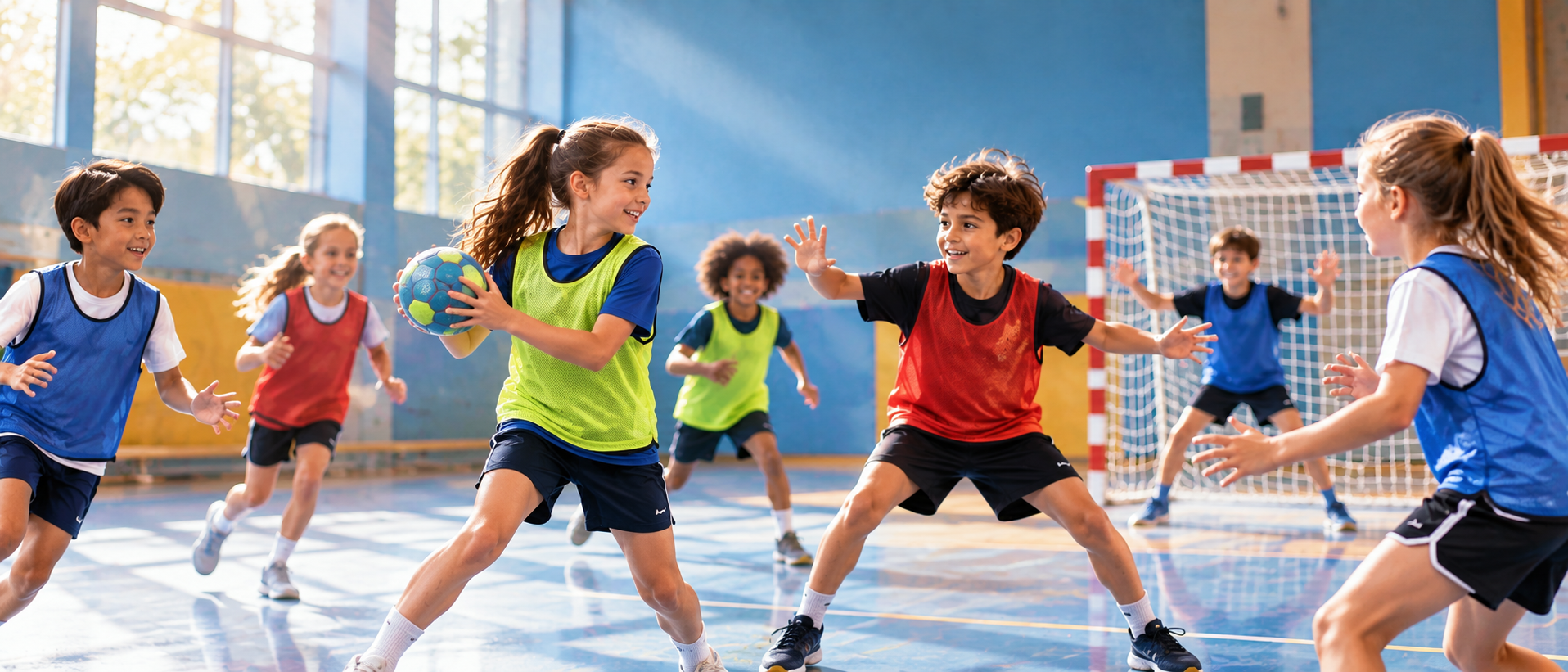
Mini handball is a simplified version of team handball created especially for children, usually between 6 and 11 years old. The objective is the same as regular handball: score goals by throwing the ball into the opponent’s net. But the rules are easier, the court is smaller, and contact is limited to keep it safe and enjoyable for kids.
Key characteristics of mini handball:
- Smaller court and goals
- Fewer players on the court
- Lighter, softer balls suited to small hands
- Simplified rules and less physical contact
- Focus on fun, teamwork, and basic skills – not on winning at all costs
Mini handball is often used in schools, clubs, and community programs to introduce kids to team sports, build confidence, and develop motor skills.
Mini Handball Court: Size, Markings, and Equipment
The mini handball court is much smaller than a standard handball court, making it easier for kids to run, pass, and shoot without getting tired too quickly.
Court Dimensions
Exact sizes may vary slightly depending on age and space available, but here’s a typical guideline:
| Element | Recommended Size | Notes |
|---|---|---|
| Court Length | 20-24 m | Shorter for younger kids |
| Court Width | 12-16 m | Use existing gym lines if possible |
| Goal Width | 2-3 m | Smaller than adult goals |
| Goal Height | 1.4-1.6 m | Adjustable or portable goals work well |
| Goal Area Line | 4-5 m from goal | Only goalkeeper allowed inside |
If you don’t have handball lines in your gym, you can mark the mini handball court with cones or tape. The most important thing is that kids clearly understand where they can and cannot go (especially the goal area).
Goals and Goal Area
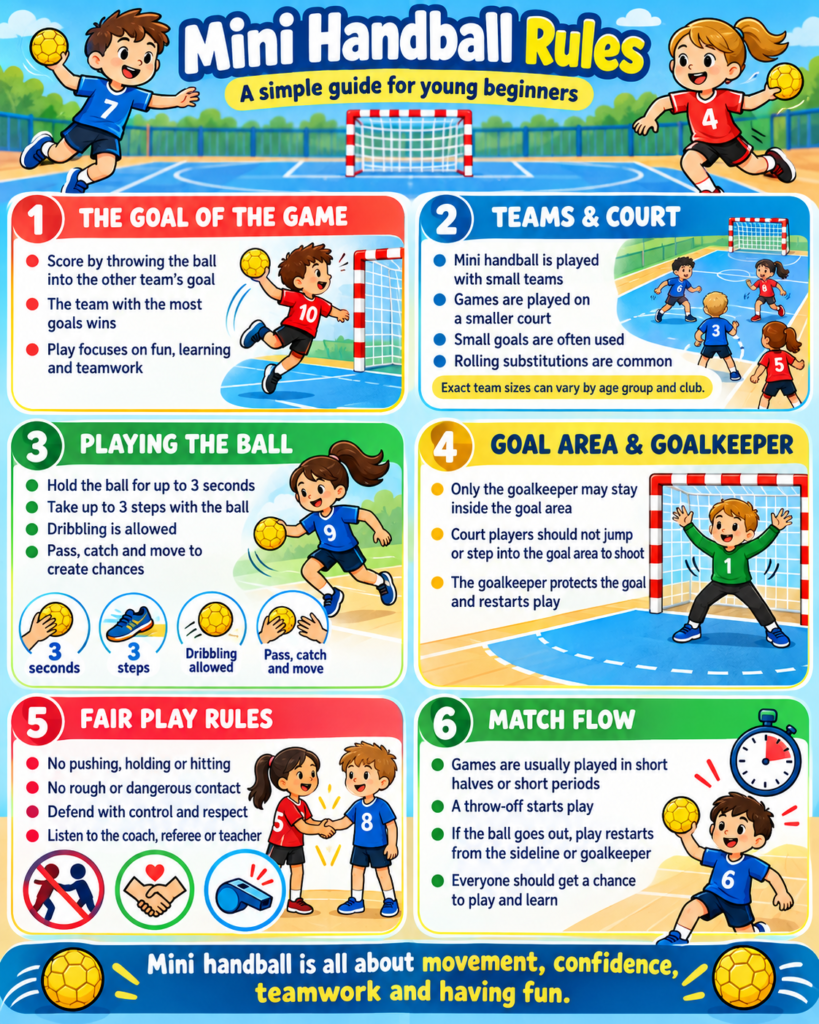
- The goal area is a semi-circle or rectangle in front of the goal, usually 4-5 meters away.
- Only the goalkeeper is allowed inside this area.
- Field players can jump into the area to shoot, but they must release the ball before landing.
- If a field player catches the ball inside the goal area, play is usually restarted with a free throw for the other team.
Ball Size for Mini Handball
Using the right mini handball ball size makes a huge difference for children’s enjoyment and safety.
| Age Group | Ball Size | Description |
|---|---|---|
| 6-8 years | Size 0 | Very small, soft, easy to grip |
| 9-11 years | Size 0 or 1 | Still light, slightly larger |
| Beginners | Soft foam ball | Ideal for first sessions and shy kids |
Choose a soft, non-slippery ball that kids can hold with one hand. This helps them learn basic handball techniques like throwing, catching, and dribbling more easily.
Mini Handball Teams: Number of Players and Positions
One of the main differences between mini handball and regular handball is the team size. Fewer players means more ball touches, more fun, and more involvement for every child.
Typical Team Size
- On-court players: 4 vs 4 or 5 vs 5 (including the goalkeeper)
- Substitutes: 2-5 extra players on the bench
- Substitutions: Unlimited and can be made at any time, as long as the player leaving the court has stepped off fully.
Smaller teams are recommended for younger age groups (4 vs 4), while older kids can handle 5 vs 5.
Basic Positions in Mini Handball
Positions are less strict than in adult handball, but it’s good to introduce the main roles:
- Goalkeeper – Defends the goal, can move freely inside the goal area and use any part of the body to block shots.
- Wingers – Play on the left and right sides, often responsible for fast breaks and wide attacks.
- Backcourt players – Play in the middle, organize attacks, and often take long shots.
For kids, rotate positions regularly so everyone experiences playing as a goalkeeper, defender, and attacker. This keeps the game fun and teaches all-round handball skills.
Basic Mini Handball Rules Explained
To keep mini handball for kids simple and inclusive, many official rules are shortened or adapted. Below is a clear overview that you can use to explain the game to young players.
Objective of the Game
The goal of mini handball is to:
- Score more goals than the opposing team
- Play fairly and respect teammates, opponents, and referees
- Develop basic handball skills: passing, catching, shooting, moving without the ball
Starting the Game
- The game starts with a throw-off from the center of the court.
- The team taking the throw-off passes the ball to a teammate to begin the attack.
- After every goal, the game restarts with a throw-off by the team that conceded the goal.
Movement with the Ball: Steps and Dribbling
To make it easy for children, many mini handball formats use a simplified version of the three-step rule from regular handball:
- A player can take up to three steps while holding the ball.
- After three steps, the player must either:
- Pass the ball
- Shoot at the goal
- Or start dribbling (bouncing the ball)
- Once the player stops dribbling and holds the ball again, they can take another three steps maximum before passing or shooting.
Some beginner or school versions allow more freedom (like four steps or no dribbling) to keep the game flowing. The key is consistency: choose simple rules and apply them the same way for all kids.
Ball Handling Rules
- Children can hold the ball for up to 3 seconds before they must pass, shoot, or dribble.
- No kicking the ball – only hands and arms are allowed (accidental contact is usually ignored for beginners).
- No diving onto the ball when it’s on the floor – this can be dangerous and should be discouraged.
Defending: What Is Allowed?
Defending is very important in handball, but mini handball puts safety first.
Allowed defensive actions:
- Blocking shots and passes with hands and arms
- Positioning your body in front of an attacker (without charging into them)
- Trying to intercept passes
Not allowed (typical mini handball fouls):
- Pushing, holding, or grabbing opponents
- Hitting the ball out of someone’s hands from behind
- Tackling or running into other players aggressively
In most youth formats, referees focus on teaching rather than punishing. Fouls often result in a free throw for the other team and a short explanation to the kids.
Goalkeeper Rules
- The goalkeeper is the only player allowed inside the goal area.
- They can touch the ball with any part of the body (hands, legs, feet, torso) when defending shots.
- When they control the ball inside the goal area, they cannot leave the area while holding it – they must pass or bounce the ball back into play.
Scoring and Match Duration
Mini handball usually has shorter matches than adult games to respect children’s concentration span.
| Age | Typical Match Time | Breaks |
|---|---|---|
| 6-8 years | 2 x 10 minutes | 5-minute break |
| 9-11 years | 2 x 15 minutes | 5-10-minute break |
| Festival/Tournament | 1 x 10-12 minutes | Short breaks between games |
Each goal counts as one point. For younger groups, many coaches place less emphasis on the final score and more on effort, fair play, and learning.
Mini Handball Gameplay: Simple Flow of the Game
To help kids understand how mini handball works from start to finish, here is a quick walkthrough of a typical game:
- Throw-off: One team starts with the ball in the center.
- Attack: Players move, pass, and try to get closer to the goal.
- Shooting: A player throws at the goal from outside the goal area line.
- Defending: The other team tries to block passes and shots without fouling.
- Goal or Save: Either the ball goes into the goal (score!) or the goalkeeper/defenders stop it.
- Possession Change:
- If a goal is scored – the other team restarts with a throw-off.
- If the goalkeeper saves and controls the ball – they pass to a teammate to start a new attack.
- If the ball goes out of bounds – throw-in or goalkeeper throw, depending on who touched the ball last.
This simple cycle repeats throughout the match, giving every child plenty of chances to attack, defend, and score.
Benefits of Mini Handball for Kids
Beyond learning the rules and basic gameplay, mini handball offers many benefits for children’s development.
- Physical fitness: Improves coordination, agility, speed, and endurance.
- Social skills: Kids learn to communicate, share the ball, and work as a team.
- Confidence: Scoring a goal, making a save, or completing a good pass builds self-esteem.
- Fair play & respect: Children learn to follow rules, respect referees, and handle winning and losing.
- Inclusive fun: With smaller teams and simplified rules, every child can participate, regardless of ability level.
Practical Tips for Coaches, Parents, and Teachers
If you’re introducing mini handball for beginners, these tips will help create a positive experience.
1. Start with Simple Games
- Begin sessions with fun warm-up games that include running, jumping, and light ball handling.
- Use small-sided games like 2 vs 2 or 3 vs 3 on mini courts to increase each child’s involvement.
- Avoid long explanations – kids learn best by playing.
2. Focus on Basic Skills First
Before talking about tactics, focus on:
- Passing and catching
- Simple movement without the ball (find space, avoid bunching up)
- Basic shooting technique (aiming at corners, using one or two steps)
3. Use Clear, Positive Coaching Language
- Explain one simple rule at a time.
- Praise effort, teamwork, and fair play more than goals scored.
- Rotate positions regularly so no one is “stuck” as goalkeeper or defender.
4. Adapt the Rules to the Group
The beauty of mini handball is flexibility. You can adapt:
- Court size – smaller space for younger or less confident players.
- Number of steps – allow one extra step for newcomers if needed.
- Contact rules – be stricter with physical play for very young children.
The goal is always the same: safe, fun, and inclusive mini handball for every child.
Example Mini Handball Session Plan (60 Minutes)
Here is a simple, practical training structure you can use for a school or club session.
| Time | Activity | Focus |
|---|---|---|
| 10 min | Warm-up game (tag with balls, relay races) | Fun, movement, activation |
| 15 min | Basic skills (passing in pairs, simple shooting) | Technique & coordination |
| 15 min | Small games (3 vs 3 or 4 vs 4 on mini courts) | Decision-making, teamwork |
| 15 min | Mini match with simplified rules | Applying skills in real play |
| 5 min | Cool-down & feedback circle | Stretching, reflection, fair play |
Conclusion: Mini Handball Rules Made Easy
Mini handball for kids is an excellent way to introduce children to team sports in a safe, exciting, and age-appropriate environment. By using a smaller court, lighter ball, fewer players, and simplified rules, mini handball allows kids to experience the joy of scoring goals, working as a team, and improving their physical skills.
To recap the essentials:
- Use a smaller court and goals designed for children.
- Play with 4-5 players per team, including a goalkeeper.
- Teach simple rules: up to three steps, limited contact, pass or shoot within a few seconds.
- Focus on fun, fair play, and participation for all kids.
Whether you’re a coach, PE teacher, or parent, understanding these mini handball rules will help you create enjoyable sessions where children can learn, move, and grow. With this simplified guide to the court, teams, and basic gameplay, you’re ready to get kids started with mini handball and watch their skills – and smiles – grow with every game.