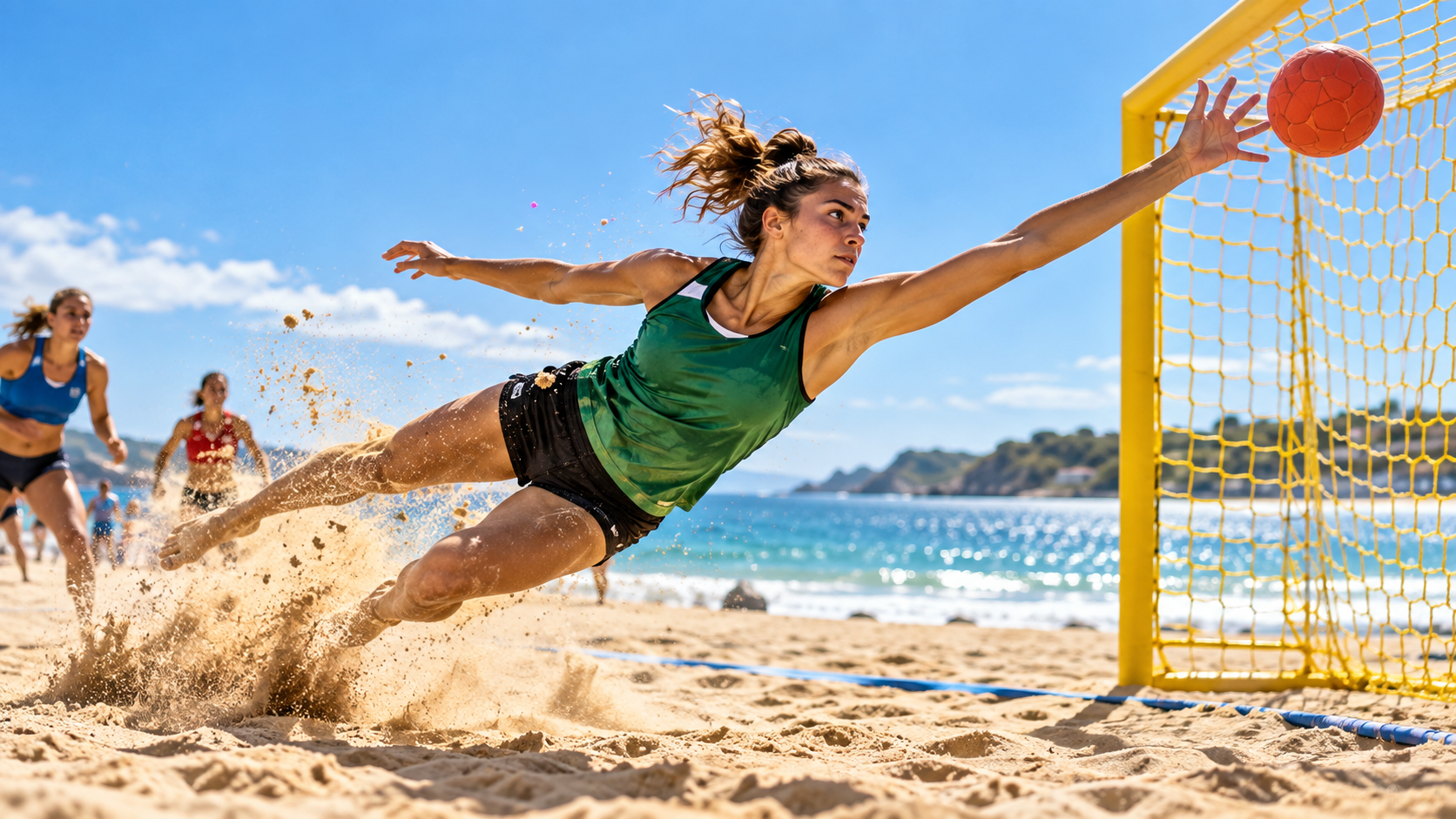
Beach handball goalkeeping is one of the most spectacular and demanding roles in the sport. A beach handball goalkeeper must combine lightning-fast reflexes, smart positioning, and fearless aerial saves – all on an unstable sand surface and against 360° spins and in-flight shots. This guide explores how to train beach handball goalkeepers effectively, with a focus on reflex training, positioning strategies, and mastering aerial saves.
If you’re a coach, player, or club looking to develop elite-level beach handball goalkeepers, this article will give you practical drills, coaching cues, and training structures that you can apply immediately.
Why Beach Handball Goalkeeping Is Unique
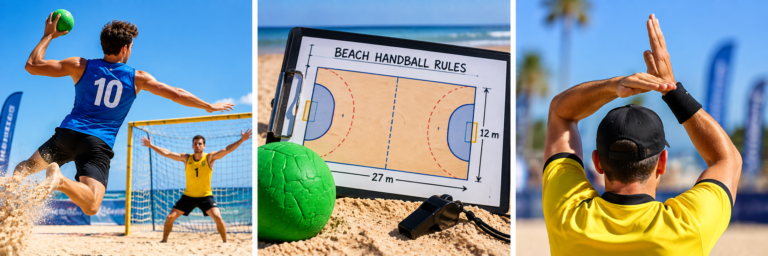
Although beach handball shares many principles with indoor handball, the role of the goalkeeper in beach handball has some key differences:
- Sand surface: Slower push-offs and jumps require better anticipation and smart positioning.
- Bonus shots: In-flight and spin shots count as 2 points, forcing goalkeepers to read complex aerial movements.
- Smaller playing area: The court is shorter, so attackers reach shooting positions faster.
- Higher scoring rhythm: Fast transitions and frequent 1-vs-1 situations increase pressure on the goalkeeper.
Because of this, specialized beach handball goalkeeper training is essential. Reflexes, positioning, and aerial save technique must all be trained together in realistic game scenarios.
Core Skills of a Beach Handball Goalkeeper
Before diving into specific drills, it’s useful to break down the main skills that define top beach handball goalkeeping performance.
| Core Skill | Why It Matters | Training Focus |
|---|---|---|
| Reflexes | React to close-range and unexpected shots | Reaction drills, visual cues |
| Positioning | Reduce shooting angles and control the goal | Angle play, footwork, body alignment |
| Aerial Saves | Stop in-flight and spin shots worth 2 points | Jump timing, landing, safe contact |
| Decision-Making | Choose when to advance, hold, or feint | Game-like scenarios, video analysis |
| Communication | Organize defense and transitions | Clear calls, shared cues |
Training Reflexes for Beach Handball Goalkeepers
Reflexes are often seen as “natural talent,” but in reality, a large part of a goalkeeper’s reaction speed can be trained through targeted exercises. In beach handball, reaction time is critical because attackers shoot mostly from close to the 6-meter line.
Principles of Reflex Training
- Short, intense repetitions: 15-20 seconds of work, followed by 20-40 seconds of rest.
- Unpredictability: Vary shooting angles, distances, and throwing patterns.
- Visual cues first, physical cues second: Teach goalkeepers to read body language and arm position, not just the ball.
Reflex Training Drills
1. Close-Range Shot Storm
Objective: Improve pure reaction speed to body-height and low shots.
- Setup: 2-3 shooters with balls at 5-7 meters, goalkeeper in the center of the goal.
- Execution: Shooters fire quick shots one after another, aiming at different body zones (high, mid, low). Every 8-10 shots, swap the goalkeeper.
- Coaching cues:
- Hands slightly forward, elbows soft.
- Small “ready hops” on the sand, not flat feet.
- Explode first, think second – no hesitation.
2. Color Call Reaction Drill
Objective: Combine cognitive load with physical reaction.
- Setup: Place four colored cones (red, blue, green, yellow) in each corner of the goal area. One coach stands behind the goalkeeper, one shooter in front.
- Execution: Coach calls a color; goalkeeper quickly points or glances at the cone, then immediately faces the shooter, who throws a shot. The goalkeeper must react from a “late” starting position.
- Variations: Use numbers, whistle patterns, or hand signals instead of colors.
3. Deflected Shot Reactions
Objective: Prepare for unpredictable bounces and deflections on sand.
- Setup: One shooter, one deflector (teammate or small mat/board) in front of the goalkeeper.
- Execution: Shooter aims at the deflector so the ball changes direction randomly. Goalkeeper reacts to late trajectory changes.
- Coaching cues:
- Keep hands “alive” and mobile.
- Stay low and balanced to change direction after deflections.
Mastering Positioning in Beach Handball Goalkeeping
Positioning is the invisible skill that makes goalkeepers “feel large” in the goal. In beach handball, correct positioning significantly reduces the number of open shots, even against high-quality attackers.
Basic Positioning Rules
- Line up with the ball, not the attacker: Always stand on the imaginary line between the ball and the center of the goal.
- Distance from the line: Generally 0.5-1.5 meters in front of the goal line, depending on:
- Shooter’s distance
- Shooter’s angle
- Your own reaction speed
- Square your shoulders: Chest facing the ball, not turned toward one post.
- Use small steps: Glide over the sand with short, quick steps rather than big jumps.
Positioning Drills on Sand
1. Angle Walk with Cones
Objective: Build a feel for optimal distance and angle on different shooting positions.
- Setup: Place cones along the 6-9 meter arc at several angles (left wing, half-left, center, half-right, right wing).
- Execution: Coach or shooter moves from cone to cone with a ball. Goalkeeper adjusts position to each point using continuous footwork, maintaining correct distance and body alignment.
- Progression: Add simple shots once positioning looks stable.
2. Mirror Footwork
Objective: Improve lateral movement and forward/backward adjustments.
- Setup: Shooter without a ball stands at 6-7 meters. Goalkeeper in front of the goal.
- Execution: Shooter moves laterally, diagonally, or backward/forward. Goalkeeper mirrors every move while staying “on the ball line” and facing the shooter.
- Add-on: After 10-15 seconds, shooter picks a side and simulates a shot; goalkeeper must react correctly from that final position.
3. Wing vs. Center Positioning Game
Objective: Train quick adjustments between extreme angles and central shots.
- Setup: Two shooters: one on the wing, one in the center. Both have balls.
- Execution: Shooters alternate shots at random. Goalkeeper must:
- Shift quickly to narrow angles on wing shots.
- Recentre quickly for central shots.
- Coaching focus: Speed and efficiency of repositioning on sand.
Developing Aerial Saves: In-Flight and High Shots
Aerial saves are a signature element of beach handball goalkeeper training. Attackers frequently use inflight plays and spin shots, and many of these aim for the upper corners of the goal. To keep 2-point attempts under control, goalkeepers must be confident leaving the ground and challenging shots in the air.
Key Components of Aerial Saves
- Timing: Jump at the moment the attacker starts their shooting motion, not too early or late.
- Arm extension: Reach high and wide with the fingers spread, covering as much space as possible.
- Body control: Maintain core tension in the air to redirect the ball or deflect it away from the goal.
- Safe landings: Land softly with bent knees and roll if necessary to avoid knee and ankle injuries on sand.
Aerial Save Drills for Beach Goalkeepers
1. High Ball Block Drill
Objective: Practice vertical jumping and high reach with safe landings.
- Setup: One coach or teammate stands at 5-6 meters and throws high lobs towards the top corners.
- Execution: Goalkeeper starts from a neutral stance, tracks the ball, then jumps to tip or catch the lob at the highest possible point. Focus on soft, controlled landings.
- Variation: Use a resistance band around the waist to emphasize upward drive and core stability.
2. In-Flight Save Simulation
Objective: Read inflight movements and time the jump correctly.
- Setup: One attacker runs for an inflight catch near the 6-meter line, assisted by a passer.
- Execution: As soon as the attacker leaves the ground for the inflight, the goalkeeper moves forward and jumps to challenge the aerial shot. The goal is not always to catch the ball but to block or disrupt the shot.
- Coaching cues:
- Step forward before jumping, don’t jump from a static position.
- Use one arm high, one slightly lower, to cover multiple levels.
3. Spin Shot Reading Drill
Objective: Anticipate and react to spin shots aimed at high corners.
- Setup: One or two attackers practice 360° spins and side spins from various angles.
- Execution: Goalkeeper focuses on:
- Reading the attacker’s shoulder and hip orientation.
- Recognizing whether the shot will go long side or short side.
- Deciding whether to stay on the line and explode laterally or jump forward.
- Progression: Add a second ball or fake pass to increase complexity.
Sample Weekly Training Plan for Beach Handball Goalkeepers
A structured plan helps ensure all key areas (reflexes, positioning, aerial saves, and physical conditioning) are covered. Below is a simple example for two goalkeeper-focused sessions per week, integrated with team practice.
| Day | Focus | Key Elements |
|---|---|---|
| Tuesday | Reflexes & Positioning | Reaction drills, angle work, mirror footwork |
| Thursday | Aerial Saves & Game Scenarios | Inflight saves, spin shot reading, 1-vs-1 |
| Weekend | Match or Scrimmage | Apply skills under pressure, video analysis |
Tip: Keep specific goalkeeper work blocks at 20-30 minutes each, then blend goalkeepers back into full-team exercises to replicate realistic beach handball match situations.
Physical Conditioning and Injury Prevention on Sand
Being a beach handball goalkeeper is physically demanding. Strong legs, stable core, and healthy shoulders are non-negotiable.
Key Conditioning Elements
- Leg strength and power: Squats, lunges, and jump variations (preferably barefoot on sand).
- Core stability: Planks, side planks, rotational exercises to stabilize aerial movements.
- Shoulder health: Band work (external rotations, Y-T-W), push-ups, and scapular stability drills.
Injury Prevention Tips
- Always warm up ankles and knees with dynamic movements before intense jumping or diving.
- Limit the number of maximal jumps per session, especially in early season.
- Practice safe landing mechanics deliberately in slow motion.
- Hydrate and protect yourself from the sun – fatigue reduces reaction time and decision-making.
Practical Coaching Tips for Beach Handball Goalkeepers
Even the best drills won’t work without clear feedback and a good learning environment. Here are a few practical tips coaches can use when training beach handball goalkeepers:
- Use simple, repeated cues: “Hands forward,” “on the ball line,” “small steps,” “see the shoulder.”
- Record short clips: Video feedback, even from a phone, is extremely powerful for understanding positioning and timing errors.
- Create pressure but keep it supportive: Goalkeepers often get blamed for goals; balance criticism with concrete, positive feedback.
- Train decision-making, not just technique: Add choices (fake shots, passes, 1-vs-1 options) so goalkeepers learn when to advance, hold, or retreat.
Short Case Example: From Indoor Keeper to Beach Specialist
Many beach handball goalkeepers start as indoor keepers. Transitioning requires focus on a few specific adaptations:
- Movement on sand: An indoor keeper who relies on powerful floor pushes must learn shorter, continuous steps and more anticipation.
- Reading aerial shots: Indoor shots are often powerful but linear. Beach shots involve more spins and inflights, demanding better tracking in the air.
- Psychology of high scoring games: Scores are usually higher in beach handball. Keepers must accept many goals and focus on key saves, especially on 2-point attempts.
Coaches working with converted indoor goalkeepers should emphasize aerial save drills, sand-specific footwork, and mental resilience during the first months of training.
Conclusion: Building Complete Beach Handball Goalkeepers
To train an outstanding beach handball goalkeeper, you need more than just basic shot-stopping drills. You must develop:
- Fast, reliable reflexes through unpredictable and high-repetition training.
- Smart positioning that reduces angles and makes saves feel “easy.”
- Confident aerial saves to neutralize inflight and spin shots that are worth 2 points.
- Physical resilience to handle repeated jumps, dives, and landings on sand.
- Strong psychology and communication to lead the defense and stay calm in high-scoring games.
By integrating these elements into a structured, progressive training plan, coaches and players can transform the goalkeeper position into a true strength of any beach handball team. Start with focused reflex and positioning drills, add aerial save work, and then continuously test everything in realistic game scenarios. Over time, your beach handball goalkeeper will not only save more shots, but also shape the flow and confidence of your entire squad.