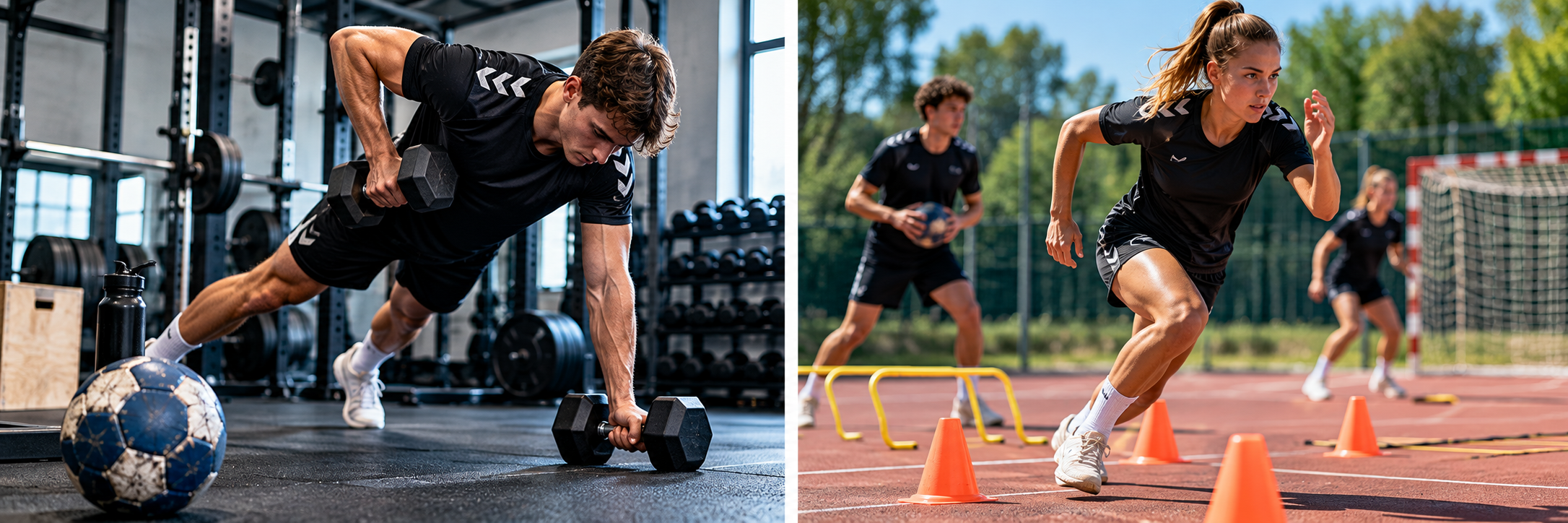
The off‑season is the secret weapon of every serious handball player. While matches stop, real progress starts. Smart off‑season handball workouts help you build strength, speed, power, and resilience so you return to the court faster, sharper, and less prone to injury.
In this guide, you’ll discover how to design effective handball strength and conditioning sessions when you’re away from the court, including gym work, home workouts, conditioning drills, and recovery strategies that keep you fresh for the upcoming season.
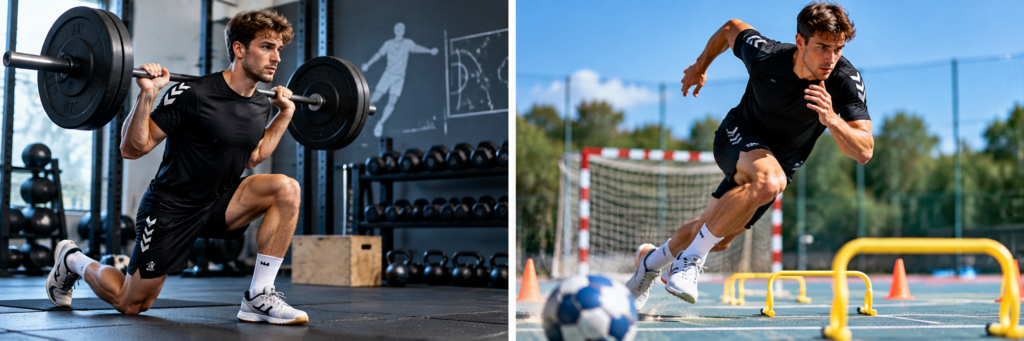
Why Off‑Season Training Matters in Handball
Handball is fast, physical, and explosive. You sprint, jump, land, push, pull, shoot, and tackle in constant rotation. Without a strong base, your performance drops and your injury risk climbs.
Key goals of off‑season handball workouts
- Build total‑body strength for powerful shots and strong duels.
- Increase speed and acceleration for fast breaks and defensive transitions.
- Improve conditioning so you stay sharp in the final minutes of each half.
- Enhance joint stability and mobility to protect shoulders, knees, and ankles.
- Fix weak links and imbalances that developed during the season.
Whether you play as a backcourt shooter, pivot, or wing, the off‑season is the best moment to focus on physical development without the constant pressure of matches and travel.
Periodizing Your Off‑Season Handball Program
A good off‑season handball training plan is structured, not random. Think in phases: rebuild, develop, and sharpen.
| Phase | Duration | Main Focus |
|---|---|---|
| Recovery & Reset | 1-2 weeks | Rest, light activity, mobility |
| Base Strength | 4-6 weeks | Hypertrophy, core, joint stability |
| Max Strength & Power | 4-6 weeks | Heavy lifting, jumps, sprints |
| Pre‑Season Transition | 2-4 weeks | Game‑specific conditioning, agility |
You can shift timelines based on how long your off‑season is, but keep the overall idea: move from general to specific, from building blocks to handball‑like intensity.
Strength Training for Handball: Building a Powerful Body
Strength is the engine behind high‑level handball performance. Strong legs mean higher jumps and faster sprints. A strong upper body supports powerful throws and solid contact. A stable core links everything together.
Key principles of handball strength training
- Train full body 2-4 times per week.
- Prioritize compound movements over isolated exercises.
- Progress gradually in weight, reps, or difficulty.
- Maintain good technique to protect joints.
Foundational lower‑body exercises
- Back or front squats – build powerful quads and glutes for jumps and duels.
- Romanian deadlifts – strengthen hamstrings and protect the knee.
- Split squats or lunges – improve single‑leg strength and balance.
- Hip thrusts – boost hip extension and sprint power.
Upper‑body strength for shooting and contact
- Bench press or push‑ups – horizontal pushing for shots and blocks.
- Pull‑ups or lat pulldowns – back strength for arm swing and shoulder health.
- Overhead press – shoulder strength for overarm throws.
- Row variations – support posture and balance shoulder workload.
Core and rotational power
- Dead bugs, planks, side planks – core stability for safe changes of direction.
- Cable chops and lifts – rotational power for shooting.
- Med ball rotational throws – mimic throwing mechanics explosively.
Sample 3‑Day Off‑Season Strength Split
| Day | Focus | Example Main Exercises |
|---|---|---|
| Day 1 | Lower‑Body Strength | Squats, RDL, split squats, core |
| Day 2 | Upper‑Body Push/Pull | Bench press, rows, overhead press, pull‑ups |
| Day 3 | Power & Core | Jumps, med ball throws, hip thrusts, planks |
Rest at least one full day between heavy sessions, and combine this with your conditioning work on separate or lighter days where possible.
Power, Speed & Agility: Playing Faster Without the Ball
Handball isn’t just about brute strength. You need quick first steps, sharp cuts, and explosive jumps. This is where handball conditioning meets speed and agility training.
Explosive power drills
- Box jumps – focus on soft landings and controlled height.
- Broad jumps – develop horizontal power for take‑offs and long strides.
- Single‑leg hops – improve stability for landing after contact.
- Med ball overhead and chest throws – power for long passes and shots.
Perform power exercises near the start of your workout, for 3-5 sets of 3-6 reps, with full recovery between sets.
Speed & agility drills for handball players
- 10-20 m sprints – work on acceleration, not just top speed.
- Shuttle runs (5-10-5 m) – simulate defensive slides and quick changes of direction.
- Ladder drills – improve footwork, especially useful for wings and defenders.
- Cone drills (T‑drill, L‑drill) – lateral movement, backpedaling, and turning.
Integrate these 2-3 times per week. Keep each session short and high quality instead of doing endless, slow reps.
Handball Conditioning: Endurance That Matches the Game
Traditional long‑duration jogging has its place in early off‑season, but handball is an intermittent high‑intensity sport. Your conditioning should reflect that.
Conditioning methods for handball players
- Tempo runs (early off‑season) – 60-80% effort, 60-100 m, repeated with short rests.
- High‑Intensity Interval Training (HIIT) – 20-30 s hard work, 30-40 s rest, repeated 10-15 times.
- Court‑style intervals (on a field or track) – 30 s sprint / 30 s jog / 30 s walk, repeated 8-10 times.
- Small‑space games (later off‑season) – if you have partners, small handball‑like games at controlled intensity.
Sample weekly conditioning structure
| Day | Type | Example |
|---|---|---|
| Mon | Intervals | 10 x 30 s run / 30 s walk |
| Wed | Tempo | 8 x 80 m @ 70% with 45 s rest |
| Sat | Mixed | Shuttles, agility + short intervals |
Adjust volume based on your position, fitness level, and how heavy your strength sessions are.
At‑Home Handball Workouts (No or Minimal Equipment)
You don’t need a full gym to follow effective off‑season handball workouts. With a resistance band, a skipping rope, and your own body weight, you can still maintain and even improve your conditioning and strength base.
Bodyweight strength circuit
Repeat 3-4 rounds, 40 s work / 20 s rest:
- Squats or jump squats (if joints tolerate impact)
- Push‑ups (hands elevated if too hard)
- Reverse lunges
- Glute bridge (single‑leg if stronger)
- Plank with shoulder taps
Band‑only upper‑body and core
- Band rows (anchor around a post)
- Band chest press
- Band overhead press
- Band rotations (pallof press, chops)
Perform 3-4 sets of 10-15 reps with controlled tempo.
Home‑based conditioning ideas
- Skipping rope – work:rest 1:1 for 10-15 minutes.
- Stair sprints – 10-15 s up, walk down, repeat 10-20 times.
- Shadow handball – practice fake moves, defensive slides, and shooting motions for 20-30 minutes.
Mobility, Prehab & Injury Prevention
Shoulders, knees, and ankles take a beating in handball. Off‑season is perfect for building durability through injury prevention exercises and mobility work.
Shoulder care for handball players
- Band external rotations (elbow tucked to side).
- Scapular push‑ups and Y‑T‑W raises.
- Thoracic spine rotations (open books, thread‑the‑needle).
Knee and ankle stability
- Single‑leg balance on the floor, then on a cushion.
- Single‑leg RDLs (with bodyweight or light weights).
- Calf raises (bent‑knee and straight‑knee).
Simple mobility routine (daily or post‑training)
- Hip flexor stretch – 30-45 s per side.
- Hamstring stretch or dynamic leg swings.
- Deep squat holds – 30-60 s.
- Shoulder dislocates with a band or towel.
10-15 minutes of consistent prehab can add seasons to your career and keep you on the court instead of on the sideline.
Sample Weekly Off‑Season Handball Workout Plan
Below is a simple, balanced structure that you can adapt to your schedule and level. It combines handball strength and conditioning, mobility, and active recovery.
| Day | Morning | Afternoon/Evening |
|---|---|---|
| Monday | Speed & agility (20-30 min) | Strength (Lower body + core) |
| Tuesday | Light conditioning (tempo runs) | Mobility & prehab (20 min) |
| Wednesday | Rest or active recovery | Optional easy bike or walk |
| Thursday | Speed & power (jumps, sprints) | Strength (Upper body + core) |
| Friday | Intervals / handball‑style conditioning | Mobility & prehab |
| Saturday | Full‑body strength (lighter, faster) | Optional technical drills or shadow handball |
| Sunday | Rest, stretching, recovery | |
Adapt volumes and intensity based on your age, current fitness, and your coach’s guidance. Quality always beats quantity.
Practical Tips to Get the Most from Off‑Season Handball Workouts
1. Set clear goals
Decide what you want from your off‑season: jump higher, get stronger, lose fat, recover from injury, or build conditioning. This helps you prioritize exercises and track results.
2. Track your progress
- Record weights, sets, and reps in a training log.
- Time your sprints and conditioning intervals.
- Note how you feel: energy, soreness, sleep quality.
3. Support training with nutrition and recovery
- Eat enough protein (roughly 1.6-2.2 g/kg body weight per day).
- Stay hydrated, especially in hot summer off‑seasons.
- Prioritize 7-9 hours of sleep per night.
- Use light days and deload weeks when you feel run down.
4. Keep some technical handball work
Even if you’re away from the court, you can still:
- Practice throwing mechanics with a light ball or med ball.
- Work on fake moves, steps, and defensive footwork without opponents.
- Watch match footage to analyze positioning and decision‑making.
5. Individualize your program
A pivot’s needs differ from a wing’s; a 17‑year‑old junior differs from a 32‑year‑old pro. Use the templates here as a base, but adjust volume, exercise selection, and intensity based on your position, history, and access to facilities.
Mini Case Study: How Off‑Season Training Transforms Performance
Here’s a simplified example of how off‑season strength and conditioning can pay off.
Profile: 22‑year‑old backcourt player, struggles in the last 10 minutes of matches and complains of shoulder soreness.
Off‑Season Focus (12 weeks):
- 3 strength sessions per week – full body, with emphasis on legs and posterior chain.
- 2 conditioning sessions per week – intervals and tempo runs.
- Daily 10‑minute shoulder prehab (rotator cuff, scapular stability).
- Gradual addition of sprints and jumps in the second half of the program.
Outcome:
- Added 15 kg to the squat and 10 kg to the bench press.
- Reduced 20 m sprint time by 0.2 s.
- No shoulder pain during heavy shooting sessions in pre‑season.
- Coach reports more consistent performance across full matches.
While every player is different, the pattern is typical: a structured off‑season creates visible gains once competition starts.
Conclusion: Turn Your Off‑Season into Your Competitive Edge
Off‑season doesn’t mean off‑handball. With the right off‑season handball workouts, you build the strength, conditioning, and resilience that allow your skills to shine when the new season begins.
Focus on:
- Structured strength training for total‑body power and stability.
- Game‑specific conditioning that trains sprints, stops, and changes of direction.
- Regular mobility and prehab work to protect shoulders, knees, and ankles.
- Smart recovery, nutrition, and sleep to support all your hard work.
If you commit to a consistent program away from the court, you’ll return not just refreshed, but transformed-stronger, faster, and ready to dominate the new handball season.