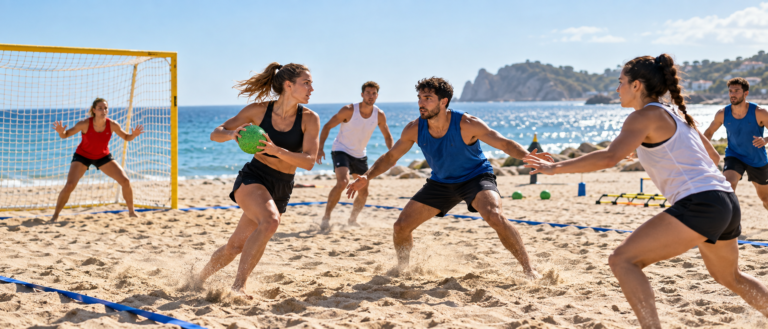

Planning a local handball tournament is one of the best ways to grow your club, engage your community, and promote the sport. Whether you’re organizing a small handball event for beginners or a competitive regional tournament, good preparation will make the experience smoother and far more enjoyable for everyone involved.
In this step-by-step guide, you’ll learn how to organize a handball tournament from scratch: from setting goals and choosing a venue, to scheduling matches, recruiting volunteers, and managing the big day. Use these practical tips to create a memorable, well-structured, and safe handball competition that players will want to return to every year.
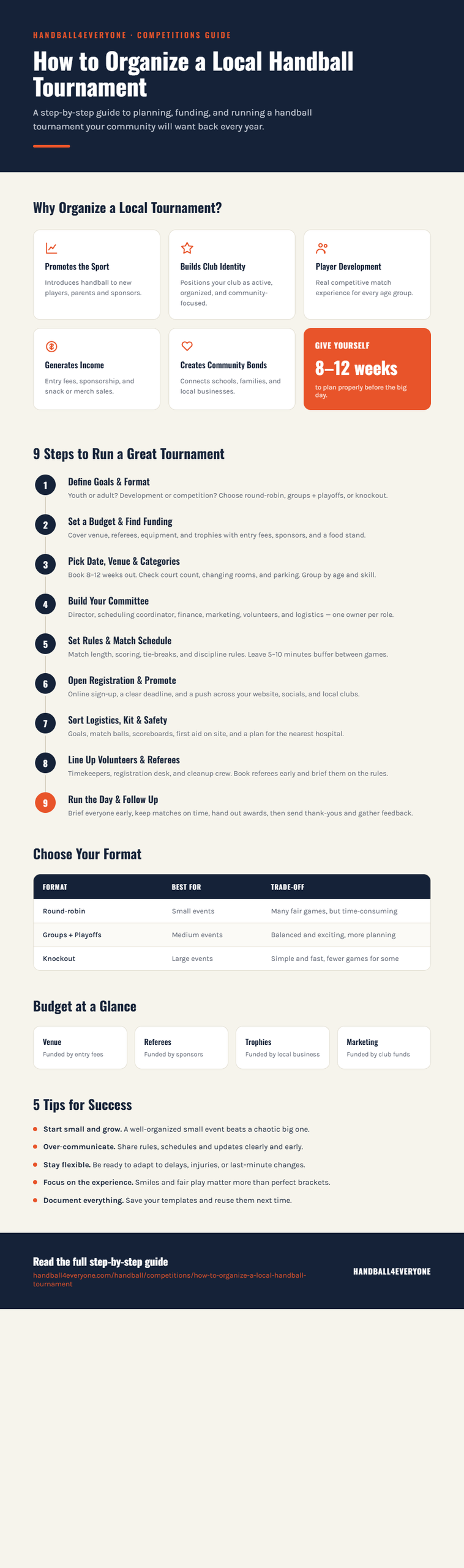
Why Organize a Local Handball Tournament?
Before diving into logistics, it helps to understand why a handball tournament is so valuable for your club or community:
- Promotes the sport locally – Introduces handball to new players, parents, and sponsors.
- Builds club identity – Positions your club as active, organized, and community-focused.
- Strengthens player development – Provides competitive match experience for all age groups.
- Generates income – Entry fees, sponsorship, and snacks/merchandise can support club finances.
- Creates community bonds – Connects schools, families, and local businesses around a common event.
With clear benefits, your committee and volunteers will be more motivated and aligned from day one.
Step 1: Define the Goals and Format of Your Handball Tournament
Good organization starts with a clear purpose. Ask yourself:
- Is this a youth handball tournament, adult competition, or mixed event?
- Do you want to focus on development (lots of games, friendly atmosphere) or competition (knockouts, trophies, rankings)?
- Is this a one-day event or a multi-day tournament?
Choose the Tournament Format
Common local handball tournament formats include:
- Round-robin (league) – Each team plays every other team in the group. Ideal for small tournaments and development events.
- Group stage + playoffs – Teams are split into groups; top teams advance to semi-finals and finals.
- Knockout (elimination) – Lose once and you’re out. Works well for a large number of teams but guarantees fewer games per team.
| Format | Best For | Pros | Cons |
|---|---|---|---|
| Round-robin | Small events | Many games, fair ranking | Time-consuming |
| Groups + Playoffs | Medium events | Balanced games & excitement | More planning needed |
| Knockout | Large events | Simple, fast | Few games for some teams |
Once you know your format, you can estimate how many teams you can host and how long your handball competition will last.
Step 2: Set a Budget and Find Funding
Creating a simple budget is essential to organize a local handball tournament that’s both sustainable and professional.
Estimate Main Costs
- Venue rental (sports hall, outdoor courts)
- Referee fees and table officials
- Equipment (balls, bibs, scoreboards, whistles, first aid)
- Medals, trophies, certificates
- Insurance and permits (if applicable in your area)
- Marketing materials (posters, social media ads, banners)
- Catering, water, and snacks
Think About Income Sources
- Team registration fees
- Local sponsorship (business logos on banners, shirts, or programs)
- Food & drinks stand
- Merchandise (club T-shirts, scarves, wristbands)
| Item | Estimated Cost | Potential Funding |
|---|---|---|
| Hall Rental (1 day) | $$ | Entry fees |
| Referees | $$ | Sponsors |
| Trophies & Medals | $ | Local business |
| Marketing | $ | Club funds |
Keep your pricing reasonable so that your handball tournament stays accessible, especially for youth and school teams.
Step 3: Choose the Date, Venue, and Age Categories
Select a Suitable Date
- Avoid clashes with major local events or holidays.
- Check your regional and national handball league schedules.
- Give yourself at least 8-12 weeks to prepare.
Find the Right Venue
Your venue can make or break your local handball event. Consider:
- Number of courts available (1-2 for small events, more for large tournaments).
- Official court size and markings for handball.
- Changing rooms, showers, and toilets.
- Spectator stands or viewing areas for parents and fans.
- Accessibility by public transport and car parking.
- Space for registration desk and refreshment area.
Define Age and Skill Categories
To keep your handball competition fair and fun, group teams into logical categories, for example:
- U12 mixed
- U14 boys / U14 girls
- U16 boys / U16 girls
- Adults (recreational / competitive)
For smaller community handball tournaments, you can mix age ranges slightly but always prioritize safety and balance.
Step 4: Build Your Organizing Committee and Roles
You can’t run a successful handball tournament alone. Create a small tournament organizing committee and define clear roles.
- Tournament Director – Overall responsibility, decision-maker, point of contact.
- Match & Scheduling Coordinator – Creates match schedules, assigns courts and referees.
- Finance Manager – Handles budget, payments, and sponsorship deals.
- Marketing & Communications – Manages social media, posters, emails, website updates.
- Volunteer Coordinator – Recruits and organizes volunteers.
- Logistics & Equipment – Deals with hall setup, scoreboards, first aid, and refreshments.
A simple shared document or project board (e.g., Google Sheets, Trello) will keep everyone aligned on tasks and deadlines.
Step 5: Create Tournament Rules and Match Schedule
Set Clear Rules and Regulations
Your local handball tournament rules should be easy to understand and publicly available before registration closes. Include:
- Age limits and eligibility criteria.
- Match duration (e.g., 2 x 12 minutes for youth, 2 x 20 minutes for adults).
- Number of players per team (on court and subs).
- Substitution rules.
- Scoring system (3 points for a win, 1 for a draw, etc.).
- Tie-breaking criteria (goal difference, head-to-head, extra time, penalties).
- Discipline rules (yellow/red cards, suspensions).
Design a Realistic Match Schedule
When planning your handball tournament schedule, keep these guidelines in mind:
- Allow at least 5-10 minutes between games to avoid delays.
- Ensure each team has reasonable rest time between matches.
- Schedule finals and key matches at times when spectators are likely to attend.
- Print and post the schedule clearly in the hall and share it online (website, social media, email).
| Time | Court 1 | Court 2 |
|---|---|---|
| 09:00 – 09:25 | U14 Group A | U14 Group B |
| 09:30 – 09:55 | U14 Group A | U14 Group B |
| 10:00 – 10:25 | U16 Group A | U16 Group B |
Always keep an updated live version of the schedule to manage delays or changes (injuries, no-shows, extra time).
Step 6: Registration, Promotion, and Communication
Set Up Team Registration
Make it easy for teams to join your tournament:
- Create an online registration form (via your WordPress site, Google Forms, or a sports management tool).
- Ask for: team name, club/school, age category, coach contact details, roster size, and payment details.
- Set a clear registration deadline and a maximum number of teams per category.
Promote Your Local Handball Tournament
Use multiple channels to attract teams, sponsors, and spectators:
- Post event information on your club website and share the link widely.
- Create a Facebook event and share on local community groups.
- Promote on Instagram, TikTok, and WhatsApp groups for players and parents.
- Send invitations to nearby clubs, schools, and sports organizations.
- Print simple posters or flyers for local gyms, sports shops, and community centers.
Include key information: date, location, age categories, registration link, and contact person. Use clear keywords like “local handball tournament in [Your City]” to improve search visibility.
Keep Communication Clear and Consistent
As the event approaches, send regular updates:
- Registration confirmation and payment details.
- Final rules and regulations.
- Match schedule and hall map.
- Parking, food options, and what teams need to bring.
Step 7: Logistics, Equipment, and Safety
Prepare Essential Equipment
For a smooth handball event, check you have:
- Official handball goals and nets in good condition.
- Match-quality handballs (correct sizes for age groups).
- Scoreboards (manual or electronic) and whistles.
- Match sheets, pens, and clipboards for table officials.
- Team bibs or colored vests if needed.
- First aid kit and ice packs.
Plan Hall Layout and Flow
- Registration desk at entrance.
- Clearly marked changing rooms and toilets.
- Separate warm-up area if possible.
- Space for spectators that doesn’t interfere with play.
- Food and drink stand away from the court but easily accessible.
Safety and Medical Coverage
Player safety must be a priority in any local sports event:
- Have at least one first aid trained person on site.
- Know the nearest hospital and emergency phone numbers.
- Ask teams to bring any relevant medical information for youth players.
- Ensure all participants are covered by insurance according to local regulations.
Step 8: Volunteers, Referees, and Officials
Reliable volunteers are crucial to organize a handball tournament successfully.
Recruit and Brief Volunteers
- Timekeeper and secretary for each court.
- Registration and info desk staff.
- Hall setup and cleanup team.
- Food and drink stand helpers.
- Photographer or social media content creator.
Provide a short written briefing with their tasks, schedule, and who to contact if problems arise.
Arrange Qualified Referees
- Contact your local or regional handball referee association early.
- Share your rules and schedule with them in advance.
- Offer fair compensation, travel reimbursement, and refreshments.
Step 9: Running the Tournament Day
On the big day, your planning pays off. Aim to create a friendly, professional atmosphere from the moment participants arrive.
Before the First Match
- Arrive early to check courts, goals, and equipment.
- Set up registration table, signage, and schedules.
- Hold a short meeting with referees and volunteers.
- Welcome coaches, explain key rules and emergency procedures.
During the Tournament
- Keep matches running on time; adjust when necessary.
- Update scores and standings regularly on a central board and online.
- Handle disputes calmly and according to your published rules.
- Capture photos and short videos for social media and future promotion.
Awards Ceremony
- Prepare medals, trophies, and certificates in advance.
- Thank teams, referees, sponsors, and volunteers publicly.
- Consider small prizes for Fair Play, Best Goalkeeper, or Top Scorer to add prestige.
Post-Tournament Follow-Up and Improvement
Once the last whistle blows, your work isn’t quite finished. To build a sustainable handball event, follow up and reflect.
Thank You Messages and Media
- Post results, photos, and a short recap article on your website and social channels.
- Tag clubs, players, and sponsors to extend your reach.
- Send personalized thank-you emails to teams, referees, and partners.
Collect Feedback
- Create a quick online survey for coaches and participants.
- Ask about organization, facilities, refereeing, scheduling, and suggestions.
- Discuss feedback in your organizing committee and note improvements for next year.
Case Study: A Small Club’s First Community Handball Tournament
Imagine a small club with just three youth teams deciding to host its first local handball tournament. They choose a one-day, eight-team U14 event in their local sports hall. With a simple group-stage format, two courts, and six volunteers, they manage:
- 12 group matches plus semi-finals and finals in a single day.
- A low entry fee thanks to local sponsorship from a sports shop and bakery.
- Over 100 spectators, including parents and curious locals who had never watched handball before.
The result? New players sign up for training, the club gains visibility, and local businesses express interest in supporting a larger event the following year. This is the power of a well-organized, community-focused handball tournament.
Practical Tips for a Successful Local Handball Tournament
- Start small and grow – It’s better to run a small but well-organized event than an overly ambitious one that feels chaotic.
- Over-communicate – Share rules, schedules, and updates clearly and early.
- Stay flexible – Be ready to adapt to delays, injuries, or last-minute cancellations.
- Focus on the experience – Smiles, fair play, and good organization matter more than perfect results tables.
- Document everything – Keep templates for schedules, emails, and budgets to reuse next time.
Conclusion: Turning Your Handball Tournament Into a Tradition
Organizing a local handball tournament for your club or community may seem like a big project, but with clear goals, good planning, and a motivated team of volunteers, it becomes an incredibly rewarding experience. You’ll promote the sport you love, strengthen your club’s reputation, and offer players of all ages a chance to compete, learn, and have fun.
By following the steps in this guide-defining your format, setting a budget, securing a venue, building your organizing committee, planning schedules, and focusing on safety and communication-you can create a well-structured, enjoyable handball event that people will look forward to year after year.
Start planning early, involve your community, and don’t be afraid to learn and improve from each edition. With each tournament, your local handball scene will grow stronger, more connected, and more vibrant.