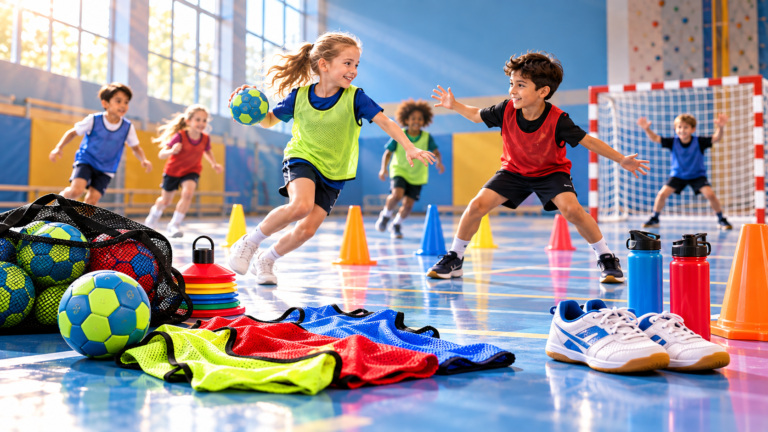

Mini handball is a fun, fast, and easy-to-learn version of traditional handball, specially adapted for children. If you’re a parent, coach, teacher, or a young player who wants to understand mini handball rules, this friendly guide will walk you through everything you need to know.
In this article, you’ll learn how mini handball works, what the basic rules are, and how to help kids enjoy the game safely while building skills and confidence. This simple guide for young beginners is perfect for primary school ages and U8-U12 youth teams.
What Is Mini Handball?
Mini handball is a simplified, small-sided version of handball designed especially for children. The court is smaller, the ball is softer, and the rules are adapted so kids can focus on having fun, learning teamwork, and developing fundamental movement skills.
Key characteristics of mini handball:
- Played indoors or outdoors on a smaller court
- Uses a soft, light mini handball for safety
- Shorter match times and flexible rules
- Emphasis on fun, participation, and fair play
Unlike full handball, which can be quite physical and tactical, mini handball focuses on basic rules and simple objectives: pass, move, shoot, and enjoy the game.
Mini Handball vs Regular Handball: Quick Comparison
| Feature | Mini Handball | Regular Handball |
|---|---|---|
| Age Group | Kids (approx. 6-12 years) | Youth & adults |
| Court Size | Smaller (often 20×13 m or similar) | 40×20 m |
| Ball Type | Soft, foam or rubber, mini size | Full-size leather/synthetic |
| Contact | Very limited, non-contact focus | Moderate body contact allowed |
| Goal Size | Smaller goals | 3×2 m standard goals |
| Main Objective | Fun, learning, participation | Competition & performance |
Basic Mini Handball Rules for Young Beginners
The exact rules of mini handball can vary slightly by country or local federation, but most youth programs use very similar guidelines. Below is a simple breakdown of the core mini handball rules that children should understand.
1. Team Size and Positions
To keep the game flowing and to make sure every child is involved, mini handball is usually played with fewer players than regular handball.
- Team size on court: 4 vs 4 or 5 vs 5 (including the goalkeeper)
- Substitutes: Extra players can rotate in and out often
- Positions: One goalkeeper and several field players (no strict positions at very young ages)
Coaches are encouraged to let kids try different roles: attack, defense, and goalkeeper, so they can discover what they like best.
2. Court and Goals
To make the game easier for young players, everything is scaled down:
- Court size: Often half a regular handball court or a small multi-sport area
- Goal size: Smaller than regulation, usually adapted to kids’ height
- Goal area: A semi-circle or marked zone in front of the goal where only the goalkeeper is allowed to stand inside
Lines can be marked with tape, cones, or floor markers if you’re setting up a mini handball game in a school gym or community hall.
3. The Mini Handball Ball
For safety and comfort, a special mini handball ball is used:
- Soft foam or rubber
- Small size to fit children’s hands
- Lightweight to reduce fear of catching or getting hit
Using the right ball encourages kids to throw, catch, and shoot with confidence.
4. Starting the Game
Mini handball games usually start with a simple throw-off from the center of the court.
- One team begins with the ball at the center line.
- Both teams stand on their own half of the court.
- On the referee’s whistle, the game begins with a pass to a teammate.
To keep things fair, teams usually change who starts with the ball in the second half.
5. Basic Ball Handling Rules
Ball handling in mini handball is designed to be simple and intuitive for children. While the exact numbers can differ by local rules, most programs use some version of these basics:
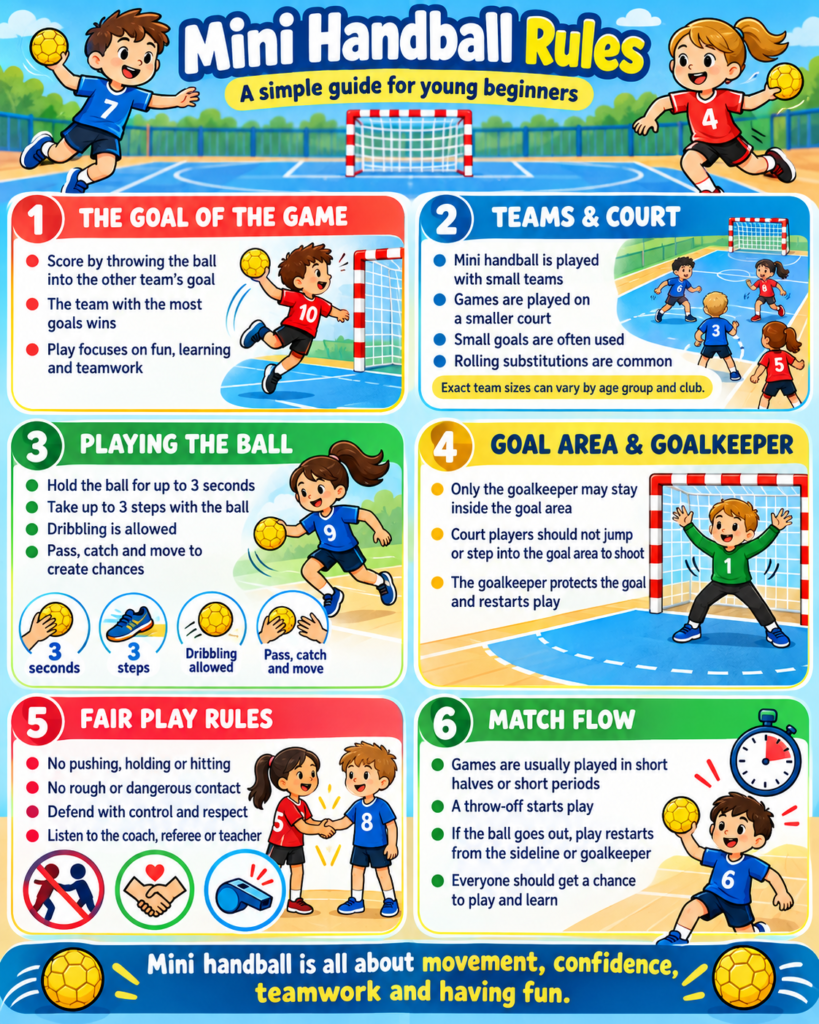
- Steps: A player can usually take up to three steps while holding the ball.
- Dribbling: Light bouncing (dribbling) is allowed, but often not required or heavily emphasized at younger ages.
- Holding time: A player should not hold the ball for more than about three seconds without passing, shooting, or dribbling.
- Passing: Players pass using one or two hands, chest passes, bounce passes, or overhead throws.
For many young beginners, coaches focus on passing and moving instead of complicated dribbling rules, so the game stays simple and team-oriented.
6. Moving and Footwork
To avoid confusion, teach these simple movement rules:
- Kids can run, jump, and change direction freely without the ball.
- With the ball, they should follow the basic “steps + time” rules.
- No traveling: if they take too many steps without dribbling or passing, the ball is given to the other team.
Explaining these mini handball rules for movement with demonstrations and fun drills helps kids understand them quickly.
7. Scoring Goals
The main objective of mini handball is the same as regular handball: score more goals than the other team.
- A goal is scored when the entire ball crosses the goal line between the posts and under the crossbar.
- Only field players can score; goalkeepers generally stay inside or near their own goal area.
- Players must shoot from outside the goal area. They can jump and shoot, but must release the ball before landing in the goal area.
Celebrate every goal and good attempt, especially in mini handball for kids, to boost confidence and enjoyment.
8. Goal Area Rules
The goal area (the semi-circle around the goal) is mainly for the goalkeeper.
- Only the goalkeeper is allowed to stand inside the goal area.
- Field players may jump over the area and shoot, but must release the ball before landing.
- If an attacker lands with the ball in the goal area, it’s a free throw for the defense.
- If a defender steps inside to block, referees may award a free throw or, in some formats, even a penalty throw.
Use cones or clear lines to make the goal area visible and easy to understand for young players.
9. Defense and Contact
One of the most important aspects of mini handball rules for beginners is safety. That’s why body contact is very limited.
- No pushing, holding, or hitting.
- Defenders should use active hands and feet to block passes and shots, not bodies.
- Staying between the attacker and the goal is encouraged.
- Referees (or coaches in training games) whistle quickly for dangerous or rough play.
The focus is on clean defense, learning positioning, and respecting other players.
10. Fouls and Free Throws
If a player breaks a rule, the other team gets a free throw from the spot of the foul (or the nearest allowed point).
- Common fouls: too many steps, rough contact, stepping in the goal area, or holding the ball too long.
- Free throw: the ball is thrown to a teammate from a stationary position, with defenders at a safe distance.
- Serious fouls near the goal may result in a penalty throw, taken from a marked line directly in front of the goal.
At beginner level, mini handball referees usually explain decisions calmly, turning each foul into a learning moment.
11. Match Duration and Substitutions
Young children tire quickly, so mini handball games are short and flexible.
- Game length: Often 2 x 10 or 2 x 15 minutes, with a short break in between.
- Rolling substitutions: Players can be changed frequently, even during play, from a designated substitution area.
- The main aim is maximum playing time for every child, not just the most skilled ones.
Coaches and teachers should plan rotations so every child spends time on court, in different positions.
Benefits of Mini Handball for Kids
Mini handball is more than just a fun game; it’s a powerful tool for child development. Here are some key benefits of playing mini handball:
- Physical development: Improves coordination, balance, agility, and overall fitness.
- Motor skills: Enhances catching, throwing, jumping, and running skills in a playful way.
- Teamwork: Teaches cooperation, communication, and trust between teammates.
- Decision-making: Children learn to make quick choices: pass, shoot, or move.
- Self-confidence: Succeeding at new skills builds self-esteem and a growth mindset.
- Social skills: Encourages respect, fair play, and dealing with winning and losing.
Because the mini handball rules are simple, kids can focus on playing and enjoying the sport without feeling overwhelmed.
Practical Tips for Parents and Coaches
To help young beginners get the most out of mini handball, consider these practical tips.
1. Keep Instructions Short and Clear
Children learn best through play and repetition. Instead of long lectures, use:
- Short rule explanations
- Demonstrations
- Simple language (“three steps, three seconds”)
2. Start with Fun Mini Games
Before playing full mini handball matches, use small activities to introduce skills:
- Throw-and-catch in pairs
- Relay races with passes
- Shooting at big targets (cones, hoops, large goals)
This keeps practice sessions engaging and lowers the fear of making mistakes.
3. Focus on Participation, Not Results
At the mini handball level, the priority is learning and enjoyment. Emphasize:
- Effort over final score
- Encouraging every child, not just the top scorers
- Rotating roles (everyone tries attack, defense, and goalkeeper)
4. Create a Positive Atmosphere
Young players will stick with the sport if they feel safe and supported.
- Celebrate small improvements.
- Discourage blaming or shouting.
- Teach respect for referees, opponents, and teammates.
5. Use Simple Visual Aids
If you’re explaining mini handball rules to children:
- Draw the court on a whiteboard.
- Use cones to mark the goal area and lines.
- Show positions with colored bibs or markers.
Sample Mini Handball Session Plan (30-40 Minutes)
| Time | Activity | Focus |
|---|---|---|
| 5 min | Fun warm-up game (tag with a ball) | Movement & fun |
| 10 min | Passing in pairs & small groups | Basic ball skills |
| 10 min | Shooting from different spots | Confidence in scoring |
| 10-15 min | Short mini handball match | Applying rules in play |
Using a simple session structure like this helps beginners learn step by step and understand how the rules of mini handball work in real situations.
Common Questions Young Players Ask
“Can I run with the ball?”
Yes, but you can only take a limited number of steps (often three) while holding it. Then you must pass, shoot, or dribble.
“Can I go inside the goal area?”
No, only the goalkeeper is allowed to stand inside. You may jump over it when shooting, but you must release the ball before landing.
“Is mini handball dangerous?”
Mini handball is designed to be safe for children: soft balls, limited contact, and clear rules. Coaches and referees stop rough play quickly.
“Do we always have to follow the same rules?”
Basic rules are important, but coaches can adapt some details (like game length or dribbling) to fit the age and level of the group.
Getting Started with Mini Handball
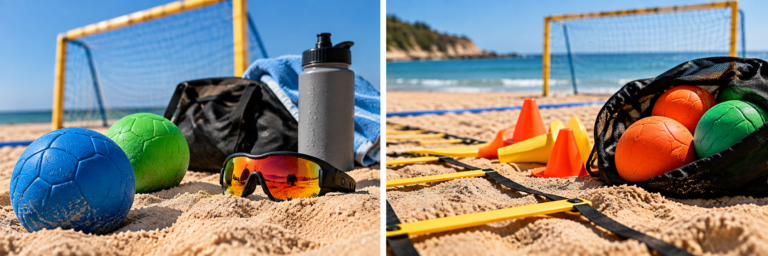
If you want to introduce mini handball for beginners at your school, club, or community center, you don’t need much:
- 1-2 soft mini handballs
- A small indoor or outdoor space
- Markers or cones for goals and lines
- 4-10 children eager to run and play
Begin with basic passes and shooting games, then gradually add the full mini handball rules as they become more confident.
Conclusion: Mini Handball Rules Made Easy
Mini handball is a fantastic introduction to team sports for children. With its simple rules, small courts, and soft ball, it creates a safe and enjoyable environment for young players to learn key skills and fall in love with physical activity.
By understanding the basic mini handball rules-team sizes, ball handling, scoring, goal area rules, and fair play-you can confidently organize sessions, support your child, or coach a beginner team. Focus on fun, learning, and participation, and the results will follow naturally.
Whether you’re a parent, teacher, or coach, mini handball offers a simple, engaging, and rewarding way to get kids moving, cooperating, and smiling. Pick up a ball, mark out a small court, and let the mini handball adventure begin.