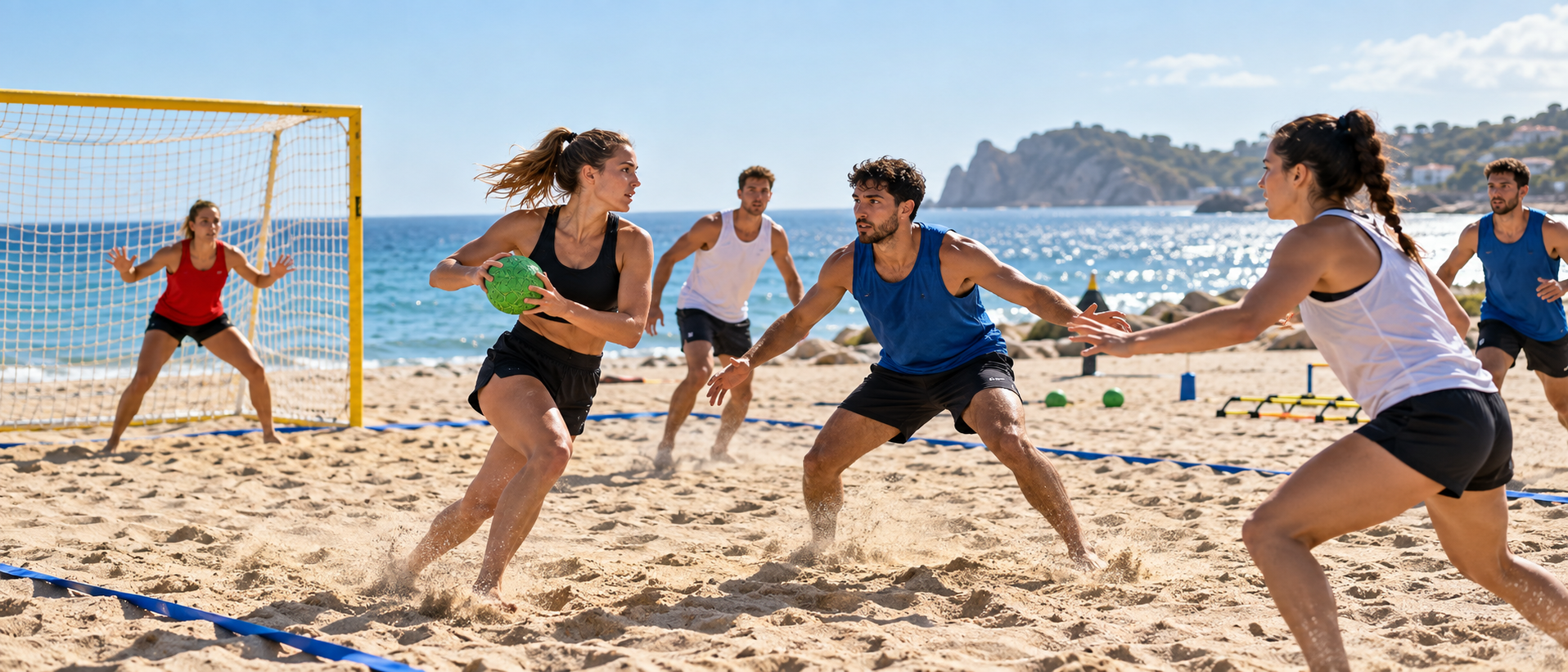
Beach handball is fast, spectacular, and tactically rich. With constant transitions, flying goals, and on‑the‑fly substitutions, teams that master the tactical basics gain a huge competitive edge. Whether you coach, play, or just love watching the sport, understanding core offensive tactics, defensive systems, and substitution strategies is essential to success on the sand.
This guide walks you through the fundamental tactics in beach handball, using clear examples and practical tips you can apply in training and matches.
Why Tactics Matter in Beach Handball
Because beach handball is played 4 vs 4 (plus goalkeepers) on a smaller court, every mistake is magnified and every smart decision can turn into a spectacular 2-point goal. Unlike indoor handball, tempo, creativity, and fast changes of players define the game.
Key reasons tactics are crucial in beach handball:
- High scoring potential: One clever move or mismatch can quickly lead to several 2-point goals.
- Small teams: Each player has major responsibility in attack and defense.
- Substitutions: Smart changes can create fresh advantages and neutralize opponents’ strengths.
- Specialist roles: Offensive and defensive specialists, as well as the flying goalkeeper, add tactical layers.
Let’s dive into the core tactical areas: offense, defense, and substitutions.
Offensive Tactics in Beach Handball
Effective offense in beach handball is built on speed, spacing, and decision-making. The goal is to constantly threaten with both 1-point and 2-point options, forcing the defense to react late or make mistakes.
1. Basic Offensive Structure
Most teams use a 3+1 structure in offense:
- 1 goalkeeper (who may come out as a flying attacker)
- 3 field players:
- Left side / playmaker
- Right side / playmaker
- Specialist (often pivot or main shooter)
The typical goal: create 2 vs 1 or 3 vs 2 situations against defenders and generate free shots or opportunities for spins and in-flight goals.
2. Key Offensive Principles
Some fundamental principles of attacking play in beach handball include:
- Width and depth: Use the full width of the court and maintain a deep attacking line to stretch the defense.
- Quick ball circulation: Fast passes prevent defenders from setting up and open gaps for breakthroughs.
- Dual threat: Always offer a 1-point shot (safe) and a 2-point shot (higher reward) in each phase.
- Simple combinations: Beach handball rewards clean, direct actions rather than overly complex patterns.
3. Common Offensive Actions and Combinations
Below are some basic actions used in beach handball offensive systems.
A. Give-and-Go (Pass and Cut)
One of the most effective and simple tactics:
- Side player passes to the center or specialist.
- Immediately cuts toward the goal or into space.
- Receives a return pass for a quick jump shot or spin.
This move is especially powerful when defenders overfocus on the specialist.
B. Pick-and-Roll on the Sand
Screening (picks) exists in beach handball too, but must remain clean and within the rules.
- The specialist sets a screen for the playmaker.
- The playmaker dribbles around the screen, attacking the space.
- Options:
- Shot after beating the defender
- Pass to specialist rolling toward the goal
- Kick-out pass to the opposite side for a spin or in-flight
C. Creating 2-Point Opportunities
Because 2-point goals can decide sets quickly, every offense should systematically create them. Main options:
- Spin shot: Shooter rotates 360° (or 720°) before releasing the ball.
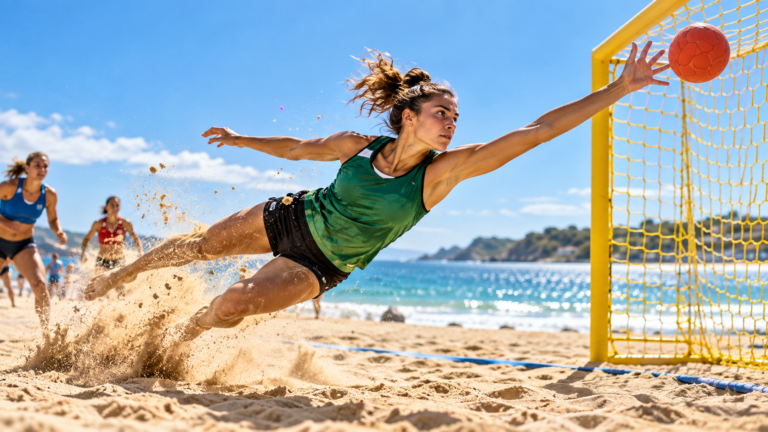
- In-flight (alley-oop): A player jumps, catches the ball mid-air, and shoots before landing.
- Goalkeeper as attacker: When the keeper joins the attack in a different jersey, any goal they score is worth 2 points.
To integrate 2-point shots without becoming predictable:
- Alternate simple jump shots and spin shots from the same action.
- Hide in-flight passes in regular passing sequences.
- Use the goalkeeper as surprise attacker only when transition and timing are safe.
4. Playing With the Flying Goalkeeper
The flying goalkeeper tactic is a trademark of beach handball offense and a core part of modern strategy.
Basic idea: The goalkeeper substitutes with a specialist wearing a different-colored jersey, acting as a fourth field player. Any goal by this player counts as 2 points.
Advantages:
- Extra attacker creates numerical superiority (4 vs 3 or 4 vs 4 with a spare player).
- Continuous 2-point threat from more positions.
Risks:
- Empty goal if possession is lost.
- Need for perfect timing on substitutions to avoid 2 players off or on simultaneously.
Teams usually use the flying goalkeeper:
- In crucial phases of a set (endgame situations).
- When chasing the score and needing extra 2-point options.
- On well-prepared set plays after time-outs.
Defensive Tactics in Beach Handball
A strong defense in beach handball does not simply stop goals; it creates fast breaks, steals, and mistakes. Because of the high value of 2-point goals, defensive tactics must prioritize controlling key shooters and preventing spins and in-flight actions.
1. Common Defensive Systems
The two most common beach handball defensive formations are:
| Defensive System | Structure | Best Use |
|---|---|---|
| 3-0 Defense | Three defenders on one line | Compact vs. strong shooters |
| 2-1 Defense | Two in front, one deeper | Flexible vs. spins & in-flights |
A. 3-0 Compact Defense
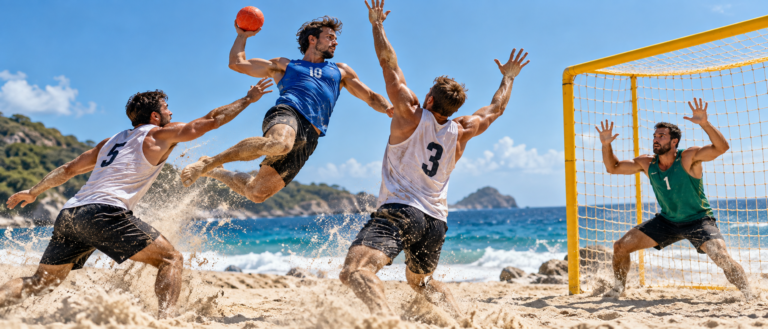
All three defenders stay relatively close together, forming a line in front of the 6 m zone.
Strengths:
- Solid against direct shots and breakthroughs.
- Good when the opponent relies on individual actions rather than complex team play.
Weaknesses:
- Less effective against well-timed in-flight actions from the wings.
- Can be stretched wide, creating gaps in the middle.
B. 2-1 Flexible Defense
Two defenders take a more advanced position; the third stays slightly behind as cover.
Strengths:
- Better angle to block passes for spins and in-flight goals.
- Allows one defender to step out and pressure the main shooter.
Weaknesses:
- Requires good communication to avoid leaving free spaces.
- Can be exploited by quick give-and-go actions.
2. Defensive Priorities
Regardless of system, basic defensive principles in beach handball are:
- Deny 2-point shots: Close down spin specialists and in-flight targets first.
- Stay active: Constant footwork, hands up, and small steps are essential on unstable sand.
- Guide, don’t chase: Force attackers into less dangerous zones or onto their weaker hand.
- Communicate roles: Decide in advance who covers the specialist, the goalkeeper-attacker, and the wings.
3. Defending Against the Flying Goalkeeper
When the opponent uses a goalkeeper as an additional attacker, your defensive tactics must adjust instantly.
Key adjustments:
- Identify the jersey: Call out when the flying goalkeeper is on; everyone must know the 2-point threat.
- Pressure early: Don’t let the extra player receive the ball comfortably.
- Interception mindset: A single steal can lead to an easy long-distance goal into the empty net.
4. Individual Defensive Skills
Team systems only work when individual players master their basics:
- 1v1 body positioning: Stay between attacker and goal, low center of gravity, arms active.
- Timing of contacts: Fouls at the wrong time can give away a 2-point opportunity or penalty.
- Reading the shooter: Learn to recognize when they prepare for a spin or an in-flight catch.
Substitution Strategies in Beach Handball
Smart substitution strategies are a hidden weapon in beach handball. With rolling substitutions and different specialists, how and when you change players can decide tight sets.
1. Types of Substitutions
In beach handball, you typically use three main forms of substitution:
- Offense-defense changes: Bringing in specialists for each phase.
- Flying goalkeeper substitutions: Keeper changes into a field player and back.
- Rotational substitutions: Managing fatigue, especially in tournaments with multiple matches a day.
2. Offensive-Defensive Specialists
Many teams use dedicated offensive and defensive players to maximize strengths.
| Role | Main Strength | Typical Use |
|---|---|---|
| Offensive Specialist | Shooting & creativity | Set attacks, key points |
| Defensive Specialist | 1v1 & steals | Opponent’s strongest line |
Tips for using specialists:
- Plan fixed substitution patterns (e.g., always after your goal or after a specific signal).
- Use clear verbal cues so everyone knows when to change.
- Practice sprinting to the substitution zone and entering without confusion or fouls.
3. Timing and Risk Management
Poorly timed substitutions can lead to easy goals conceded or offensive breakdowns. To avoid this:
- Substitute on defense when possible, to reduce risk of counterattacks.
- Switch the flying goalkeeper only when your team has secure ball possession.
- In the last seconds of a set, decide clearly: all-in on attack or secure the draw/win with safer defense.
4. Managing Fatigue and Momentum
Beach handball tournaments often mean several games in one day under the sun. Effective substitution strategy also covers:
- Short, intense shifts: Keep players fresh to maintain speed in attack and defense.
- Momentum changes: After a series of conceded 2-point goals, a quick triple substitution can reset intensity.
- Protect key players: Give your main specialist short breaks even when they’re performing well; you’ll need them in the final points.
Benefits of Strong Tactics in Beach Handball
Developing clear tactical basics in offense, defense, and substitutions brings several advantages for teams at any level:
- More efficient attacks: Better shot selection and higher 2-point conversion.
- Fewer simple goals conceded: Improved organization and communication in defense.
- Better use of your roster: Each player fits into a clear role within the tactical system.
- In-game adaptability: Ability to switch between systems (e.g., 3-0 to 2-1) depending on opponents.
Practical Training Tips to Improve Tactics
To bring these beach handball tactics from theory into practice, integrate them into your training sessions.
1. Small-Sided Tactical Games
- Play 3 vs 3 or 2 vs 2 with specific rules (e.g., only spin goals count, or mandatory pick-and-roll).
- Limit time in attack (e.g., 10 seconds) to simulate match pressure.
- Reward creative 2-point attempts even when they miss, to build confidence.
2. Focused Substitution Drills
- Practice fast offense-defense changes from the substitution zone.
- Simulate situations with the flying goalkeeper entering and leaving several times in a row.
- Use whistles or visual cues so players learn to react quickly and automatically.
3. Video Analysis and Tactical Talks
- Record training games and review them with players.
- Pause and discuss moments of poor spacing, missed 2-point chances, or late substitutions.
- Watch professional beach handball matches together and analyze offensive and defensive systems.
Sample Tactical Scenario: Turning a Set Around
Imagine your team is down by 6 points late in a set. Here is how combined tactics can help:
- Substitution strategy: You bring in your offensive specialist and activate the flying goalkeeper for the next 3 attacks.
- Offensive tactic: Run a simple pick-and-roll to free the specialist for a 2-point spin shot, then an in-flight on the next attack.
- Defensive adjustment: Switch from a 3-0 to a 2-1 defense, with your best defender stepping out early on their spin shooter.
- Result: If you manage two successful 2-point attacks and force one turnover against their empty goal, the set is suddenly balanced again.
This scenario shows how offense, defense, and substitution tactics work together to create momentum shifts in beach handball.
Conclusion: Building a Tactical Identity in Beach Handball
Tactical basics in beach handball are not about copying professional teams, but about finding a system that suits your players and developing it consistently. Focus on:
- A clear offensive structure with regular 2-point opportunities.
- A flexible defensive system that can adjust to different opponents.
- Smart, well‑trained substitution strategies to maximize your strengths and manage fatigue.
Start simple, master the fundamentals, and gradually add layers: more advanced set plays, creative spins, and intelligent use of the flying goalkeeper. Over time, your team will build a recognizable tactical identity that makes you harder to read and more dangerous on the sand.
Apply these concepts in your next practice, and you’ll quickly see how much more controlled, confident, and effective your beach handball can become.