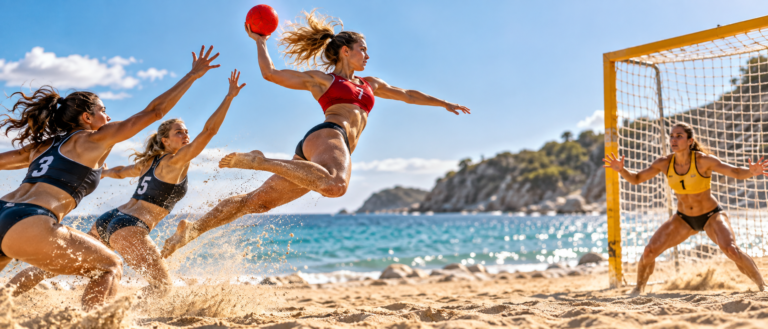
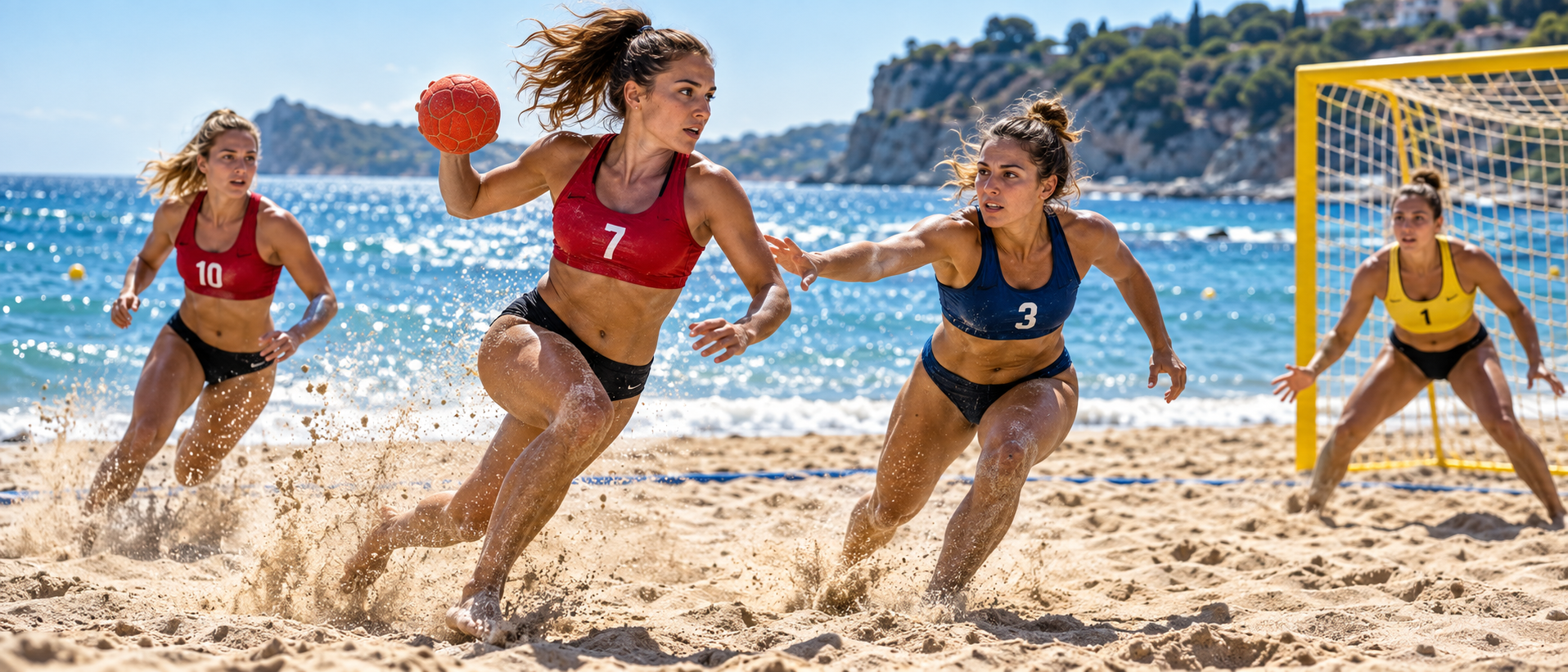
Beach handball is fast, dynamic, and physically demanding. The sand surface makes every sprint, jump, and change of direction more challenging than on a traditional court. That’s why footwork and agility drills for beach handball players are essential if you want to defend better, create space on attack, and win more one-on-one duels.
In this guide, you’ll find practical, game-specific drills, strength and conditioning ideas, and coaching tips to help you move smarter and faster on sand, not just harder.
Why Footwork and Agility Matter in Beach Handball
On sand, poor footwork is punished immediately. You lose balance, sink too deep, or waste energy getting out of the sand instead of moving efficiently. Building your agility for beach handball is about more than speed; it’s about control, balance, reactivity, and coordination.
Key reasons footwork and agility are crucial:
- Faster defensive reactions: Quickly close shooting lanes, adjust to spin shots, and cover the pivot.
- Explosive attacks: Create separation from defenders for 360° or in-flight shots.
- Better balance on sand: Stay stable after jumps, landings, and physical contact.
- Energy efficiency: Move with less wasted effort so you can maintain intensity during long tournaments.
- Injury reduction: Strong, coordinated feet and ankles help prevent sprains and overuse injuries.
Fundamentals of Footwork on Sand
Before you add complex agility drills for beach handball, you must master the basics of moving on sand. Technique matters as much as fitness.
1. Stance and Center of Gravity
- Keep your hips low and knees slightly bent.
- Distribute weight on the balls of the feet, not on the heels.
- Keep your chest up and arms free for balance and contact.
2. Stride Length and Foot Placement
- Use shorter, quicker strides instead of long, heavy steps that sink you deeper into the sand.
- Drive your foot down and back, not just straight down.
- Avoid stamping; aim for a light, quick ground contact even though the surface is soft.
3. Direction Changes
- Lower your center of gravity before you cut or change direction.
- Use your outside leg as the braking and pushing leg when changing direction.
- Turn your hips quickly towards your new direction to avoid slow pivots.
Warm-Up for Footwork and Agility Training on Sand
A smart warm-up prepares your muscles and joints for intense beach handball agility drills and reduces injury risk.
Dynamic Warm-Up Sequence (10-12 minutes)
- Jog in sand (2-3 minutes) – Light jog along the sideline, gradually increasing tempo.
- Dynamic mobility (4-5 minutes):
- Leg swings (forward and sideways)
- Hip circles
- Ankle circles and calf raises
- Lunges with rotation
- Activation drills (3-4 minutes):
- Short high knees and butt kicks in place
- Quick side shuffles
- Mini jumps on both feet and single-leg hops
Core Footwork and Agility Drills for Beach Handball Players
The following sand footwork drills are designed specifically for the demands of beach handball. Adjust volumes to your level and training phase.
1. Sand Line Shuffles
Goal: Improve lateral movement, defensive slides, and short accelerations.
How to do it:
- Mark a 4-6 meter line with cones.
- Start in an athletic stance at one cone.
- Shuffle sideways to the other cone, touch it with your hand, then shuffle back.
- Keep your chest up, feet wide, and avoid crossing your legs.
Sets & Reps: 4-6 repetitions of 15-20 seconds, rest 30-40 seconds between reps.
2. Zigzag Cone Sprints
Goal: Improve quick direction changes and acceleration on sand.
How to do it:
- Place 6-8 cones in a zigzag pattern about 2-3 meters apart.
- Sprint diagonally from cone to cone.
- Slow down just before the cone, lower your hips, plant the outside foot, and explode towards the next cone.
- Focus on quick, powerful steps, not long slow strides.
Sets & Reps: 3-5 sets with 1-2 zigzag runs per set. Rest 60-90 seconds between sets.
3. 360° Close-Out Drill
Goal: Simulate defensive close-outs on shooters making spins and fakes.
How to do it:
- Place one cone in the center and 4 cones around it in a circle (about 3-4 meters away).
- Start at the center cone in low defensive stance.
- Coach or partner calls out a cone (e.g., “front left”).
- Explode to that cone, stop under control in front of it (as if closing to a shooter), then backpedal to the center.
- Repeat for 20-30 seconds with random calls.
Sets & Reps: 3-4 rounds of 20-30 seconds, rest 40-60 seconds.
4. Pivot & Spin Footwork Drill
Goal: Enhance turning speed and balance for attackers and defenders.
How to do it:
- Stand in the middle of two cones 3-4 meters apart.
- Sprint to the first cone and touch it.
- Perform a quick 180° or 360° turn and sprint to the other cone.
- Focus on planting firmly, rotating fast, and regaining balance quickly.
Sets & Reps: 4-6 runs, each 15-20 seconds, rest 30 seconds.
5. Multi-Directional Hop Matrix
Goal: Improve ankle stiffness, reactivity, and control on sand.
How to do it:
- Mark a small plus-sign (+) shape in the sand with four directions.
- Stand in the center on one leg.
- Hop forward, back to center, sideways right, back to center, sideways left, back to center, backward, back to center.
- Keep landings soft and controlled; avoid collapsing in the ankle or knee.
Sets & Reps: 2-3 rounds per leg, 8-12 hops per round. Rest 30-45 seconds.
Position-Specific Agility Drills for Beach Handball
Different positions demand slightly different beach handball agility profiles. Tailor your footwork training to your role.
| Position | Main Footwork Focus | Recommended Core Drill |
|---|---|---|
| Wings | Sideline sprints & sharp cuts | Zigzag Cone Sprints |
| Specialists / Shooters | Explosive first step & spin entries | Pivot & Spin Footwork Drill |
| Pivots | Short power moves & stable base | Multi-Directional Hop Matrix |
| Goalkeepers | Lateral quickness & short dives | Sand Line Shuffles |
| All Players | Reactive movement in all directions | 360° Close-Out Drill |
Advanced Agility Drills with the Ball
To maximize transfer to real games, combine footwork drills for beach handball with ball handling and decision-making.
1. Reactive Cone Color Drill with Ball
Goal: Improve reaction time, dribbling on sand (where permitted), and quick changes of direction.
Set-up:
- Place 4-6 cones of different colors in a half-circle around the player.
- Player holds the ball in both hands.
Execution:
- Coach calls out a cone color.
- Player sprints to that cone, performs a quick feint (or fake shot), and returns to start.
- Repeat with random, fast color calls for 20-30 seconds.
2. Two-Step & Spin Entry Drill
Goal: Improve the explosive first step before executing spin shots.
How to do it:
- Start 5-6 meters away from the goal area line.
- On the whistle, take two powerful steps forward in the sand.
- Perform a controlled 360° spin (with or without a jump, depending on level).
- Land balanced and simulate a shot or pass.
Coaching tips: Emphasize foot placement and balance after the spin more than shot power at first.
3. Small-Sided Agility Games
Use simplified game formats to train agility with real decision-making:
- 1v1 on short width: Short court with defender pressuring attacker. Attacker must create space with quick cuts and spins.
- 2v2 transition: Start from a defensive position and transition quickly to attack, focusing on fast direction changes and supportive runs.
- Defensive mirror drill: One player leads with random side steps, shuffles, and pivots; the other mirrors every move at close distance.
Programming a Weekly Footwork & Agility Plan
To see real progress, you need consistent, well-structured training. Here’s a simple example of a weekly agility workout plan for beach handball players.
| Day | Focus | Suggested Content |
|---|---|---|
| Monday | Footwork Technique | Warm-up + Sand Line Shuffles + Hop Matrix |
| Wednesday | Agility & Speed | Zigzag Sprints + 360° Close-Outs + Sprints |
| Friday | Game-Specific Drills | Ball-based agility + Small-sided games |
Guidelines:
- Limit intense agility sessions to 2-3 times per week to avoid overuse.
- Do agility and speed work early in a session, before heavy strength or conditioning.
- Rest 48 hours between very intense agility workouts.
Strength and Stability to Support Agility on Sand
Elite agility in beach handball is built on a base of strength and stability. A few targeted exercises can make a big difference.
Essential Strength Exercises
- Single-leg squats or lunges – Build leg strength and balance.
- Calf raises on sand – Strengthen calves and Achilles tendon.
- Glute bridges and hip thrusts – Improve hip power for sprints and jumps.
- Core work (planks, side planks, dead bugs) – Keep your trunk stable during spins and contacts.
Balance and Proprioception
- Single-leg stands in sand with eyes closed.
- Catch-and-throw games while standing on one leg.
- Controlled single-leg hops forward and backward.
Practical Tips to Maximize Footwork and Agility Training
- Quality over quantity: Short, intense reps with good form are better than long, sloppy drills.
- Train barefoot when possible: It improves foot strength and feel for the sand. If needed, use sand socks for hot or rough surfaces.
- Use video feedback: Record drills and check posture, stride length, and hip position.
- Progress difficulty gradually: Start with simple patterns, then add speed, ball work, and decision-making.
- Hydrate and protect from sun: Training on sand in heat is demanding; plan breaks and shade.
Sample 30-Minute Beach Handball Agility Session
Here’s a ready-to-use 30-minute agility training session you can run with your team or individually:
- Warm-up (8 minutes)
- Jogging in sand – 2 minutes
- Dynamic mobility – 4 minutes
- Short shuffles and mini-hops – 2 minutes
- Core Agility Block (15 minutes)
- Sand Line Shuffles – 4 x 20 seconds
- Zigzag Cone Sprints – 3 x 2 runs
- 360° Close-Out Drill – 3 x 25 seconds
- Game-Specific Block (5-7 minutes)
- Two-Step & Spin Entry Drill – 4-6 reps per side
- Short 1v1 duels – 2-3 rounds of 30 seconds
First-Hand Coaching Insights and Common Mistakes
Experienced beach handball coaches often see the same errors when athletes train footwork and agility on sand. Being aware of these mistakes can speed up your improvement.
Common Mistakes:
- Standing too tall: Players move upright and lose stability; remind yourself to bend knees and lower hips.
- Overstriding: Long strides make you sink deeper into the sand and slow you down.
- Neglecting the weak side: Many players only spin or cut effectively to one side; train symmetrical moves.
- Skipping rest: Fatigue leads to sloppy technique and higher injury risk.
- Ignoring off-season work: Agility gains are easier to build in the off-season when game load is lower.
Conclusion: Turn Sand into Your Advantage
Footwork and agility are not optional extras for beach handball players; they are the foundation of high-level performance. With targeted footwork and agility drills for beach handball players-from basic shuffles and hops to complex ball-based and position-specific exercises-you can turn the sand from a challenge into your best ally.
Start by improving your stance and basic movement patterns, then progress to reactive and game-like drills. Combine agility work with strength, stability, and smart load management, and you’ll feel the difference in every sprint, every cut, and every spin shot.
Build these drills into your weekly routine, track your progress, and keep the focus on quality movement. Over time, your improved agility on sand will translate directly into more goals, better defense, and a stronger overall beach handball game.