Handball fans often hear about both beach handball and indoor handball, but the rules, court, and style of play are surprisingly different. Whether you’re a player, coach, or sports enthusiast, understanding the key differences between beach handball rules and indoor handball can deepen your appreciation of both versions and help you choose which one fits you best.
In this guide, we’ll break down the major rule differences, game formats, scoring systems, and practical tips to help you transition between the two sports smoothly.
What Is Beach Handball vs. Indoor Handball?
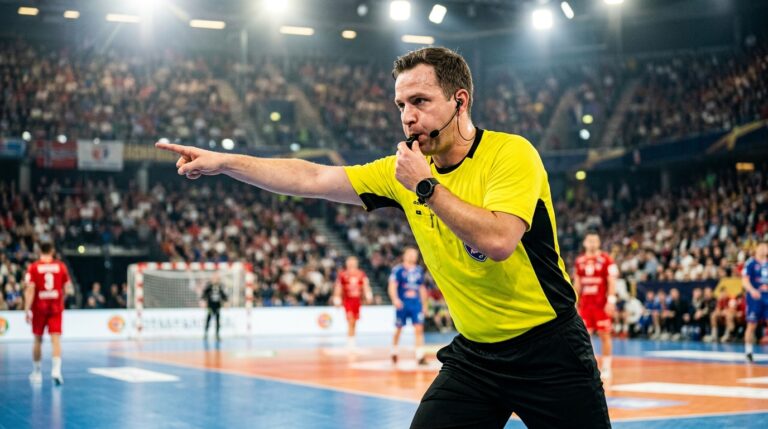
Indoor handball is the traditional, Olympic team sport played on a hard court inside a sports hall. It’s fast, physical, and often compared to a mix between basketball and futsal.
Beach handball is the younger, more acrobatic variant played on sand, often at the beach or on temporary sand courts. It emphasizes spectacular goals, fair play, and entertainment, with a strong focus on creativity.
| Aspect | Indoor Handball | Beach Handball |
|---|---|---|
| Main Surface | Hard indoor court | Sand court |
| Team Size on Court | 7 players | 4 players |
| Match Format | 2 x 30-minute halves | 2 sets + shoot-out if tied |
| Goal Value | Most goals = 1 point | Standard goals + 2-point “special” goals |
1. Court and Equipment Differences
Indoor Handball Court
- Dimensions: 40m x 20m hard court
- Goal area: 6m semi-circle around the goal
- Ball: Leather or synthetic, slightly larger and heavier
- Footwear: Indoor court shoes with good grip
Beach Handball Court
- Dimensions: 27m x 12m sand court
- Goal area: 6m from the goal line, but the whole court is sand, so movement feels different
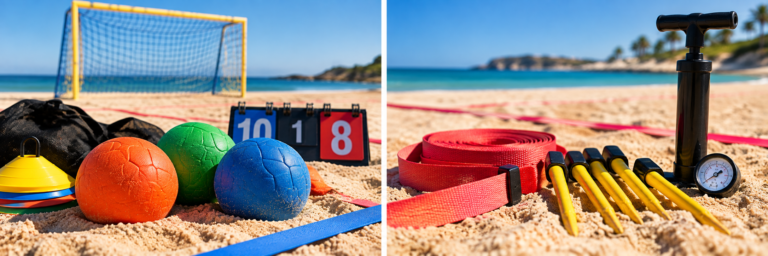
- Ball: Softer, grippy rubber ball, slightly smaller and lighter
- Footwear: Generally played barefoot, with special rules about injuries and hot sand
The sand court and lighter ball in beach handball favor acrobatic moves, like spins and aerial shots, which are central to its scoring system and rules.
2. Team Composition and Substitutions
Indoor Handball Team Structure
- 7 players on the court: 6 court players + 1 goalkeeper
- Substitutes: Up to 7 additional players on the bench
- Substitutions: Unlimited, “on-the-fly” through a substitution area along the sideline
- Specialist roles: Wings, backs, line player (pivot), goalkeeper
Beach Handball Team Structure
- 4 players on the court: 3 court players + 1 goalkeeper
- Smaller squads: Typically 4-8 substitutes available
- Substitutions: Also unlimited and on-the-fly, but used more tactically because of specialized offensive/defensive roles
- Role flexibility: Players frequently rotate between attack, defense, and goalkeeper-specialist roles
The reduction from 7 to 4 players per team in beach handball creates more space and encourages faster transitions and individual creativity compared to the dense tactical structures of indoor handball.
3. Match Format and Duration
Indoor Handball Match Structure
- Standard match time: 2 halves of 30 minutes (for adults)
- Half-time: Usually 10-15 minutes
- Winner: Team with the most goals after 60 minutes
- Draws: Possible in league play; in knockouts, extra time and possibly penalty throws decide the winner
Beach Handball Match Structure
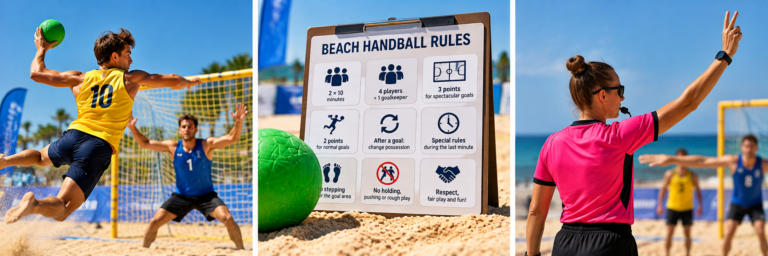
- Played in sets: 2 x 10-minute periods (called “sets”)
- Set winner: Team that scores more points in that 10-minute set
- Match winner: First team to win two sets
- If teams win one set each: A shoot-out (1-on-1 with the goalkeeper) decides the match
This set-based format is one of the most important differences between beach handball and indoor handball rules. It adds drama and allows comebacks, even if a team loses the first set by a big margin.
| Format | Indoor | Beach |
|---|---|---|
| Game Structure | Continuous 60 minutes | Best of 2 sets + shoot-out |
| Time Per Segment | 2 x 30 minutes | 2 x 10 minutes |
| Tied Result | Extra time / throws | Decided by shoot-out |
4. Scoring System: 1-Point vs. 2-Point Goals
Indoor Handball Scoring
- Every valid goal = 1 point, regardless of how it’s scored
- No bonus points for trick shots or special moves
- Strategy focuses on creating high-percentage shooting opportunities and exploiting defensive gaps
Beach Handball Scoring
This is where beach handball rules stand out dramatically.
- Standard goal: 1 point
- 2-point goals:
- 360° spin shot (pirouette) that results in a goal
- Alley-oop style goal (aerial catch + shot before landing)
- Goal scored by the goalkeeper when acting as a field player
- Occasionally other spectacular or clearly defined plays, depending on competition rules
The two-point scoring rule in beach handball encourages risk-taking and spectacular, audience-friendly play. Teams often design their attacks specifically around creating 2-point opportunities rather than simply shooting at the goal.
5. Defensive Rules and Physical Contact
Indoor Handball Defense
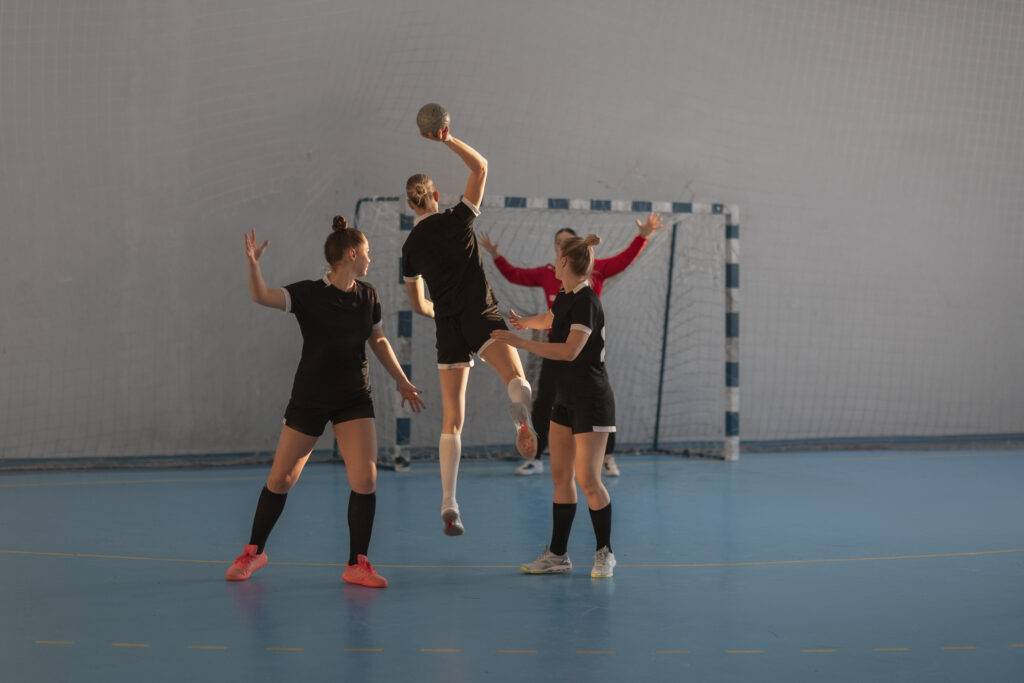
- More physical: Body contact is allowed as long as it is controlled and targeted at the torso
- Common fouls: Holding, pushing, hitting the arm, blocking improperly
- Sanctions:
- Free throws for minor fouls
- 2-minute suspensions, yellow and red cards for repeated or serious fouls
- Defensive systems: 6-0, 5-1, 3-2-1, and other formations
Beach Handball Defense
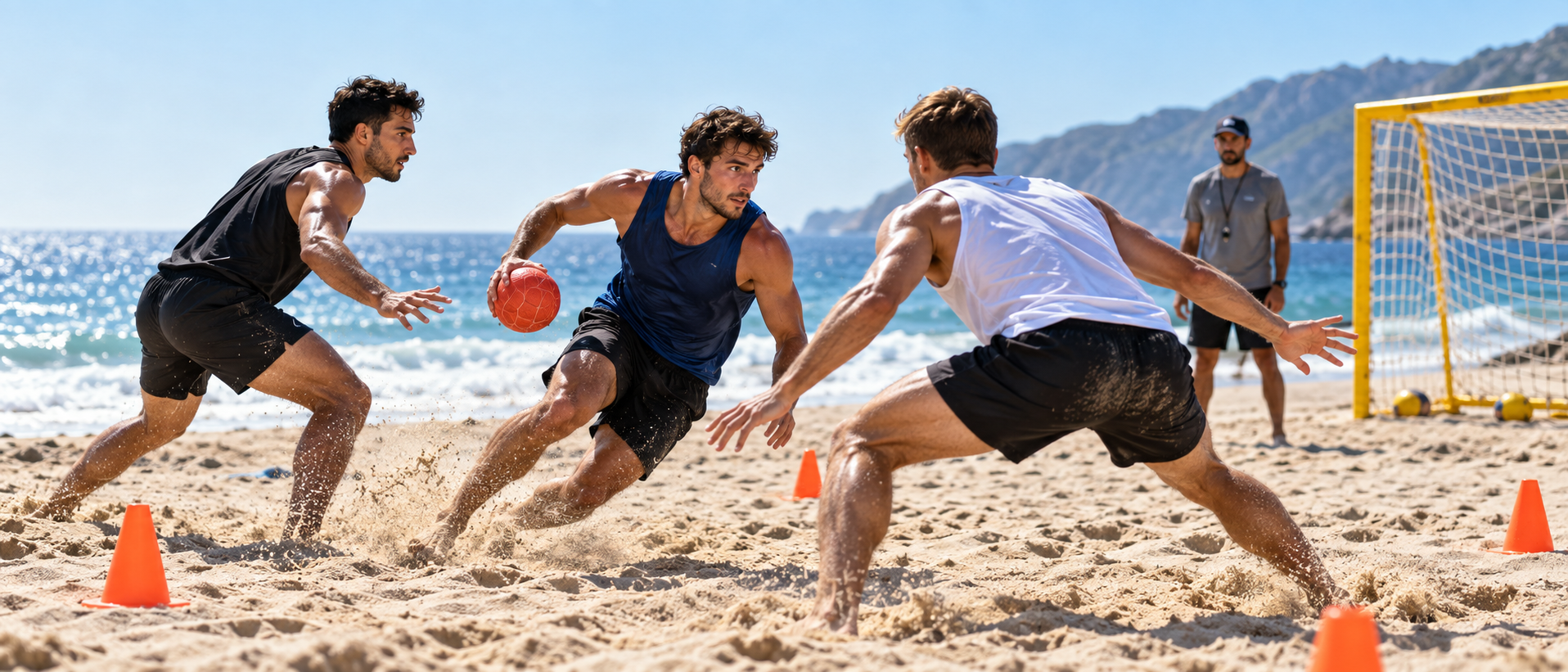
- Less physical: The sport emphasizes fair play and flow; rough body contact is quickly penalized
- Because of the sand and acrobatic plays, safety is a major concern
- Defensive contact is more restricted, which opens up spectacular offensive moves
- Defensive systems are more fluid, often adjusted on the fly due to the smaller number of players
While both sports require strong, coordinated defense, indoor handball is noticeably more physical. Beach handball focuses more on speed, positioning, and intercepting passes rather than heavy contact.
6. Goalkeeper Rules and Role
Indoor Handball Goalkeeper
- Primarily stays in the 6m area
- Can join the attack as a 7th field player (wearing a different shirt), but this is mostly a tactical late-game option
- Goals scored by the goalkeeper are worth 1 point like any other
Beach Handball Goalkeeper
- Highly dynamic role – often participates actively in offense
- When the goalkeeper joins the attack and scores, it counts as a 2-point goal
- Specialist “goalkeeper-player” can create numerical superiority and increase scoring potential
The goalkeeper’s impact on the score is much higher in beach handball due to the 2-point goal rule. Many beach handball tactics revolve around quick transitions between goalkeeper and attacker roles.
7. Penalties, Suspensions, and Shoot-Outs
Indoor Handball Penalties
- 7-meter throw: Awarded for clear scoring chances illegally prevented
- Suspensions: 2-minute exclusions for serious or repeated fouls
- Red card: Disqualification; team plays short for 2 minutes, then can replace the player
Beach Handball Penalties
- 6-meter throw: Equivalent of a penalty throw, taken closer due to the smaller court
- Sanctions: Progressive punishments for unsportsmanlike behavior or rough contact
- Shoot-out: If each team wins one set, the match is decided by a dramatic 1-on-1 shoot-out format
In a beach handball shoot-out, an attacker typically starts from their own goal area, receives the ball from their goalkeeper, and then runs toward the opponent’s goal to face the opposing goalkeeper in a 1-on-1 situation. This format highlights speed, timing, and creativity, and can decide entire tournaments in a few seconds.
8. Tempo, Tactics, and Playing Style
Indoor Handball Playing Style
- Structured tactics: Set plays, systems, and well-rehearsed offensive patterns
- Physical duels: Line player battles, blocks, and strong backcourt shooting
- Transitions: Fast breaks and quick returns to organized defense
Beach Handball Playing Style
- High tempo: Short sets and small court area encourage constant movement
- Creativity over structure: Spin shots, flying goals, and trick plays are a core part of the game
- Flexible tactics: Systems revolve around creating 2-point chances and exploiting mismatches
Both sports are fast-paced, but beach handball feels more like a show with its emphasis on acrobatics and high-risk, high-reward moves. Indoor handball leans more toward structured team tactics and physical strength.
9. Benefits of Playing Beach Handball vs. Indoor Handball
Benefits of Indoor Handball
- Develops explosive power, agility, and upper-body strength
- Teaches complex tactical understanding and coordinated team play
- Widely recognized, with professional leagues and Olympic status
Benefits of Beach Handball
- Sand reduces impact on joints, making it gentler on knees and ankles
- Improves balance, footwork, and core stability
- Encourages creativity, improvisation, and individual flair
- Fun, festival-like atmosphere attracts new players and younger audiences
Many clubs and national teams now use beach handball as a summer training tool to maintain fitness, reduce injury risk, and build technical skills that transfer back to the indoor court.
10. Practical Tips: Switching Between Beach and Indoor Handball
For Indoor Handball Players Trying Beach Handball
- Adapt your footwork: Running and jumping on sand is more demanding; shorten your steps and focus on balance.
- Practice spin shots: Learn 360° jumps and aerial catches to maximize 2-point scoring opportunities.
- Work on quick transitions: Beach games switch from defense to attack very fast; be ready to change roles instantly.
- Protect your skin: Use sunscreen, hydrate well, and be mindful of hot sand conditions.
For Beach Handball Players Moving Indoors
- Increase physical strength: Indoor defenses are tougher; strength and conditioning are crucial.
- Learn set systems: Familiarize yourself with common offensive and defensive formations.
- Adjust your shooting: Power and accuracy from distance become more important indoors.
- Change in footwear: Get comfortable with indoor shoes and the different type of grip and movement they require.
11. Summary Table: Beach Handball Rules vs. Indoor Handball
| Rule Category | Indoor Handball | Beach Handball |
|---|---|---|
| Court Size | 40m x 20m | 27m x 12m |
| Surface | Hard floor | Sand |
| Players on Court | 7 (6+GK) | 4 (3+GK) |
| Match Format | 2 x 30-min halves | 2 x 10-min sets + shoot-out |
| Scoring | All goals = 1 point | 1- and 2-point goals |
| Physical Contact | More allowed, very physical | More limited, focus on fair play |
| Goalkeeper Goals | Worth 1 point | Worth 2 points |
| Tie-Break | Extra time / 7m throws | 1-on-1 shoot-out |
Conclusion: Which Version of Handball Is Right for You?
When you compare beach handball rules vs. indoor handball, you’re really looking at two branches of the same exciting sport. Indoor handball delivers intense physical battles, tactical depth, and the prestige of long-established competitions. Beach handball offers spectacular, quick-fire games, creative scoring, and a relaxed, festival-style atmosphere.
If you enjoy structure, physicality, and high-level competitive leagues, indoor handball is a natural choice. If you prefer creativity, acrobatics, and a fun, outdoor environment, beach handball might become your new favorite sport.
For many players, the ideal solution is simple: play both. Use beach handball to sharpen your skills, enjoy the summer, and bring new ideas back into your indoor game. Whichever you choose, understanding the key rule differences between beach handball and indoor handball will help you make smarter decisions on the court-and enjoy every minute of play.