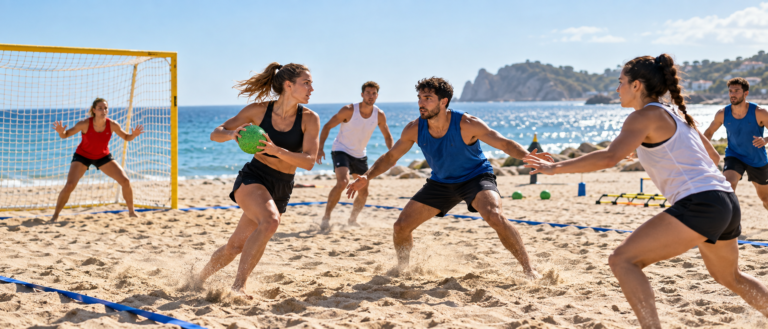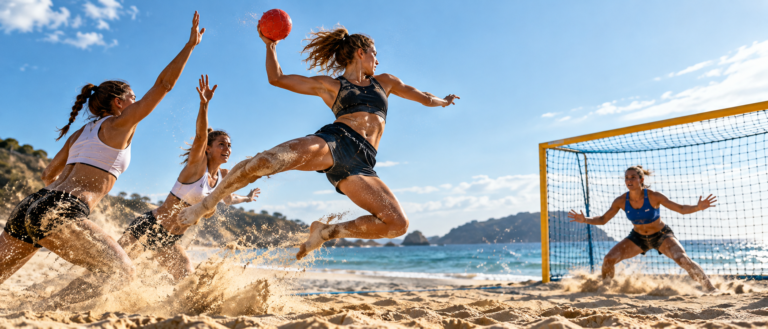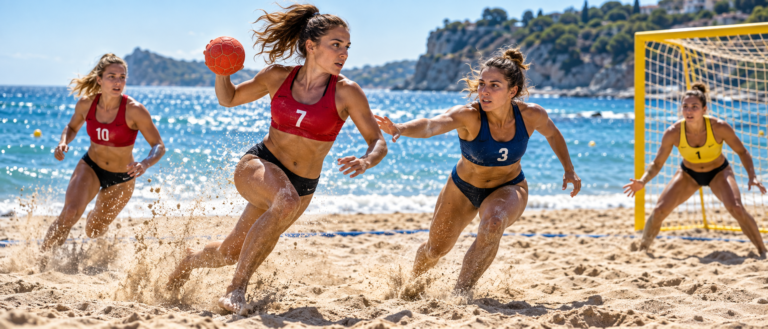
Beach handball is fast, explosive, and spectacular to watch — but it’s also physically demanding. The constant changes of direction, jumps, and dives on an unstable surface challenge even the fittest athletes. To perform at your best (and avoid injury), you need smart, specific training for beach handball on sand.
This in-depth guide covers everything you need to know about conditioning and drills for beach handball, including warm-ups, strength work, agility drills, and sample training sessions you can use right away.
Why Training on Sand Is Different
Beach handball isn’t just indoor handball moved outdoors. Sand changes everything:
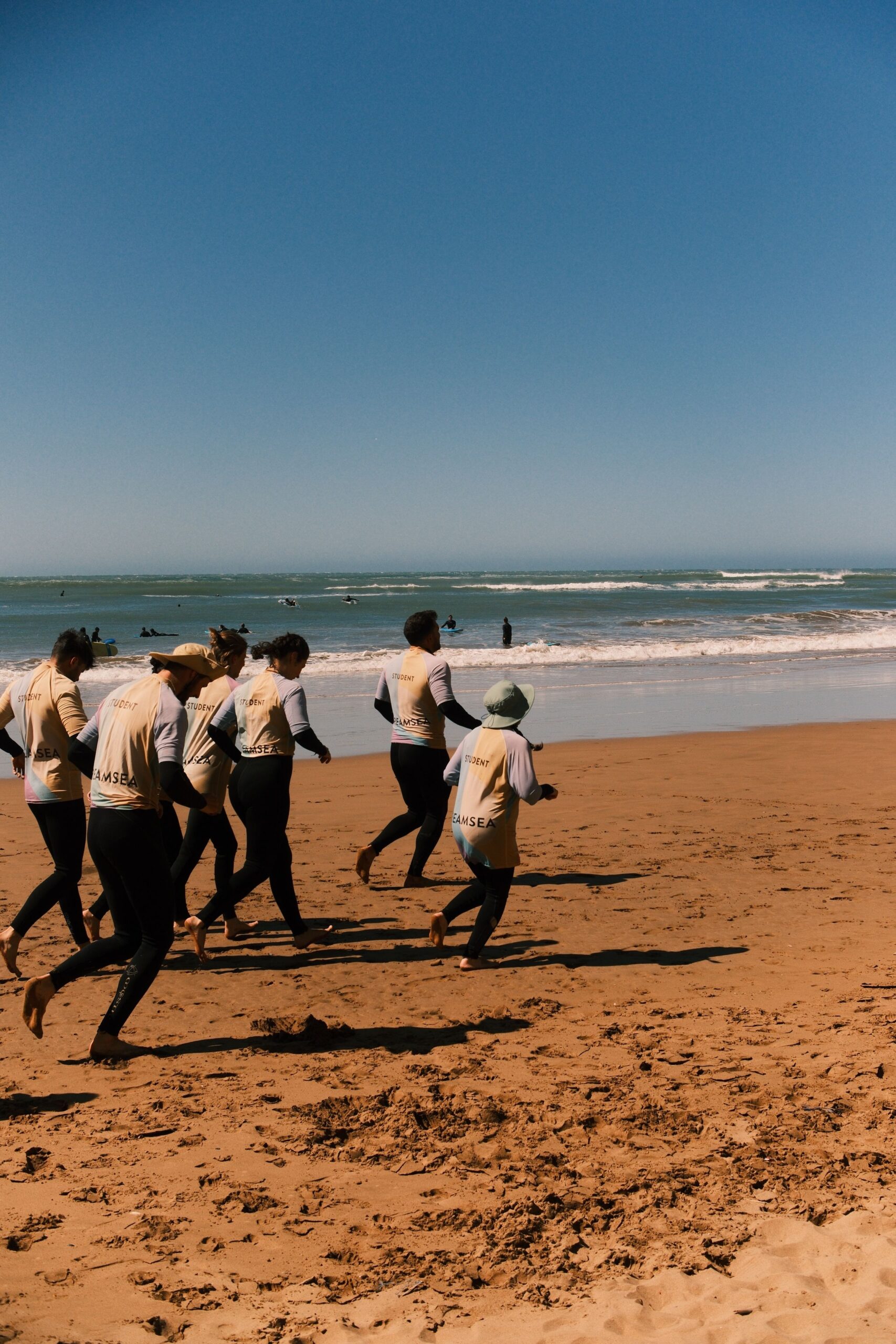
- Unstable surface — Sand absorbs force and shifts under your feet, forcing more engagement of stabilizing muscles in your ankles, knees, and hips.
- Reduced traction — You can’t push off as hard, so you must learn to accelerate, stop, and change direction efficiently on a softer base.
- Higher energy cost — Running on sand can require up to 1.6–2x more energy than running on firm ground.
- Different impact profile — Landings and dives are softer, which is good for joints, but muscles and tendons still work hard to stabilize.
That’s why specific beach handball conditioning is essential. The goal is to build strength, power, and endurance tailored to the demands of playing on sand.
Key Physical Demands in Beach Handball
Design your beach handball training to match the sport’s main physical requirements:
| Physical Quality | Why It Matters on Sand |
|---|---|
| Lower-body strength | Powerful jumps, sprints, and stops in soft sand |
| Core stability | Balance, spins, and throwing while off-balance |
| Speed & agility | Quick accelerations, feints, and direction changes |
| Anaerobic endurance | Repeated high-intensity actions during sets |
| Grip & shoulder strength | Secure ball handling and powerful shots |
Every drill and workout you plan for beach handball training should target at least one of these qualities.
Warm-Up for Beach Handball: Prepare to Move on Sand
A good warm-up reduces injury risk and improves performance. On sand, it should include:
1. General Activation (5–7 minutes)
- Light jogging on sand: forward, backward, and sideways
- High knees and butt kicks at low intensity
- Side shuffles and gentle cross-steps
2. Dynamic Mobility (5–8 minutes)
- Leg swings (front/back and side-to-side)
- Walking lunges with twist
- Hip circles and ankle rolls
- Arm circles and shoulder rotations
3. Specific Beach Handball Prep (5 minutes)
- Short 10 m accelerations on sand
- Skips and bounds with soft landings
- Ball-handling: one-hand catches, spins, wrist snaps
Keep the intensity gradually increasing. By the end of the warm-up, you should feel warm and slightly out of breath, not exhausted.
Strength and Conditioning for Beach Handball
You don’t need a full gym on the beach to get stronger. A mix of bodyweight strength exercises, resistance bands, and occasional off-sand work can build the power and robustness you need.
Lower-Body Strength Exercises
Focus on movements that translate directly to beach handball actions:
- Squats (bodyweight, goblet, or barbell off-sand)
- Split squats and lunges (forward, reverse, lateral)
- Hip thrusts / glute bridges
- Calf raises (both straight-leg and bent-knee)
Typical prescription (in pre-season): 3–4 sets of 6–10 reps, 2–3 times per week.
Core and Trunk Stability
Core strength is crucial for spins, overhead shots, and stability when landing on sand.
- Front and side planks (20–40 seconds)
- Dead bugs and bird-dogs
- Russian twists with a ball
- Pallof presses with a band (anti-rotation)
Upper-Body and Shoulder Health
For powerful, safe throwing and beach handball defense:
- Push-ups (regular, incline, or decline)
- Band pull-aparts and external rotations
- Rowing movements (TRX, bands, or dumbbells)
- Overhead carries (with light dumbbells or kettlebells)
Aim for 2–3 sessions per week, 2–4 sets of 8–15 reps, focusing on control over load.
Speed, Agility, and Footwork Drills on Sand
Explosiveness and quick feet separate strong beach handball players from the rest. The following drills develop speed and agility on sand without needing much equipment.
Short Sprint Drills
- 10–15 m accelerations: 6–10 reps, walk back as rest.
- Flying sprints: 10 m build-up + 10 m max speed, 4–6 reps.
- Shuttle runs: 5–10–15 m and back, 4–6 reps.
Agility and Change-of-Direction
- T-drills: Sprint forward, shuffle sideways, backpedal.
- 4-corner drill: Cones in a square — forward, lateral, and diagonal movements.
- Reaction drills: Partner calls directions (left/right/sprint/back) for 10–20 seconds.
Footwork and Balance
- Ladder drills drawn in the sand: in-in-out-out, side steps, hopscotch patterns.
- Single-leg balance on uneven sand with ball catches.
- Hop-and-stick: small hops forward, hold landing for 2 seconds.
Plyometric Training for Jumping and Spinning on Sand
Plyometrics train your muscles and nervous system to be explosive. On sand, they’re slightly safer for joints, but you still need good technique.
Lower-Body Plyometrics
- Squat jumps: Focus on full extension and soft landings.
- Lateral bounds: Jump sideways off one foot, land on the other.
- Split jumps: Switch legs in the air from a lunge position.
- Box jumps onto a stable low box (off-sand if possible).
Beach Handball-Specific Jumps
- Take-off practice for 360° spins: step sequence + jump + controlled spin, no ball at first.
- One-leg to two-leg landings: simulate diving take-offs and controlled landings.
- Jump-stop-jump sequences: mimicking fake jumps and second efforts.
Do plyometrics 1–2 times per week, 3–5 sets of 5–8 quality reps. Rest fully between sets to maintain explosiveness.
Beach Handball Ball-Handling and Shooting Drills
Technical skills must be trained in the same environment you compete in. That means ball-handling drills on sand, under fatigue and with realistic movement patterns.
Ball Control and Passing on Sand
- Partner passing with movement: both players shuffle or jog; alternate chest, bounce, and overhead passes.
- One-handed catches: throw slightly off-target to challenge reach and grip.
- Quick passes in a small square: 3-4 players, limit touches and increase speed gradually.
Shooting Drills for Beach Handball
- Set shots: static shooting from different angles and distances.
- Running shots: 3-5 steps with changes of direction before shooting.
- Spin shots: start without a ball to learn the footwork, then add the ball and build to full 360° attempts.
- Inflight and alley-oop shots: practice timing with a partner lobbing the ball.
Combining Skills with Conditioning
To simulate game intensity, combine technical drills with conditioning:
- 10 m sprint + catch + jump shot — 6 reps per side.
- Agility ladder pattern + quick give-and-go pass + spin shot.
- Defensive shuffle (5 m left/right) + block attempt + counterattack sprint and finish.
Endurance and Conditioning for Beach Handball
Beach handball is played in short, intense bursts with quick breaks. Your conditioning should reflect that: prioritize high-intensity interval training (HIIT) on sand over long, slow runs.
Interval Conditioning Ideas
- 15-15 intervals: 15 seconds max run, 15 seconds rest, 2-3 sets of 8-10 reps.
- 30-30 intervals: 30 seconds hard, 30 seconds easy jog/walk, 2-3 sets of 6-8 reps.
- Shuttle conditioning: 5-10-15 m shuttles for 20 seconds, 40 seconds rest, 6-10 reps.
Small-Sided Games
The most sport-specific conditioning is small-sided beach handball games:
- 2v2 or 3v3 on a reduced court
- Play 1-2 minute rounds with 1 minute rest
- Emphasize continuous movement and quick transitions
Rotate players frequently to keep intensity high.
Sample Weekly Training Plan for Beach Handball
Here’s a simple example of how you might structure a pre-season week focusing on conditioning and drills for playing on sand.
| Day | Focus | Key Elements |
|---|---|---|
| Monday | Strength + Core | Gym or bodyweight, 45-60 min |
| Tuesday | Speed + Skills on Sand | Sprints, agility, shooting |
| Wednesday | Active Recovery | Mobility, light swim, walk |
| Thursday | Plyometrics + Small-Sided Games | Explosive jumps, 3v3 games |
| Friday | Strength + Shoulder Health | Push/pull, rotator cuff work |
| Weekend | Match Play or Scrimmage | Game scenarios, tactics |
Adjust volume and intensity based on your level, recovery, and competition schedule.
Practical Tips for Safe and Effective Beach Handball Training
1. Progress Gradually on Sand
If you’re new to it, don’t jump into daily high-intensity sand sessions. Start with 1-2 sand workouts per week, then build up as your body adapts.
2. Protect Your Feet and Ankles
- Warm up your ankles thoroughly with circles and balance drills.
- Consider sand socks on very hot or rough sand.
- Check the training area for hidden objects before you start.
3. Hydration and Sun Protection
- Drink water regularly before, during, and after sessions.
- Use sunscreen and sunglasses; train in cooler hours when possible.
- Take short breaks in the shade if sessions are long.
4. Monitor Fatigue
Heavy legs, poor coordination, and sloppy landings are signs to reduce volume or intensity. Quality matters more than quantity in beach handball performance training.
Beginner vs. Advanced Beach Handball Training Focus
| Level | Main Training Focus |
|---|---|
| Beginners | Basic footwork, simple passes, safe landings, moderate conditioning |
| Intermediate | Stronger legs and core, small-sided games, intro to spins and inflight shots |
| Advanced | High-intensity intervals, complex combos, tactical drills, recovery optimization |
Putting It All Together: A Sample Beach Handball Session
Here’s a 75-90 minute beach handball training session you can adapt for your team:
- Warm-up (15 minutes)
- 5 min easy jog and dynamic movements
- 5 min mobility (hips, ankles, shoulders)
- 5 min short accelerations + ball-handling
- Speed & Agility (15-20 minutes)
- 6 × 10 m sprints (walk-back rest)
- 4 × T-drill at moderate intensity
- 2 × 10-15 second reaction drills with partner commands
- Plyometrics & Jump Technique (10-15 minutes)
- 3 × 6 squat jumps
- 3 × 6 lateral bounds per side
- Spins and take-off rehearsal without ball (4-6 reps each side)
- Technical Skills (20-25 minutes)
- Partner passing with movement (5-8 minutes)
- Running shots from both wings (8-10 minutes)
- Spin shot progression or inflight drills (8-10 minutes)
- Conditioning / Small-Sided Games (10-15 minutes)
- 3v3 games, 4 × 2 minutes, 1 minute rest
- Cool-down (5-10 minutes)
- Light walking, breathing exercises
- Static stretching for legs, hips, shoulders
Conclusion: Train Smart, Play Hard on the Sand
Success in beach handball depends on more than just talent. You need targeted conditioning and drills for playing on sand that build strength, speed, agility, and technical skills under realistic conditions.
By incorporating:
- Structured warm-ups tailored to sand
- Lower-body and core strength training
- Speed, agility, and plyometric drills
- Sport-specific ball-handling and shooting practice
- Interval-based conditioning and small-sided games
you’ll become a more explosive, resilient, and skillful beach handball player. Whether you’re preparing for your first tournament or trying to reach an elite level, consistent, smart training on sand will help you perform at your best when it matters most.