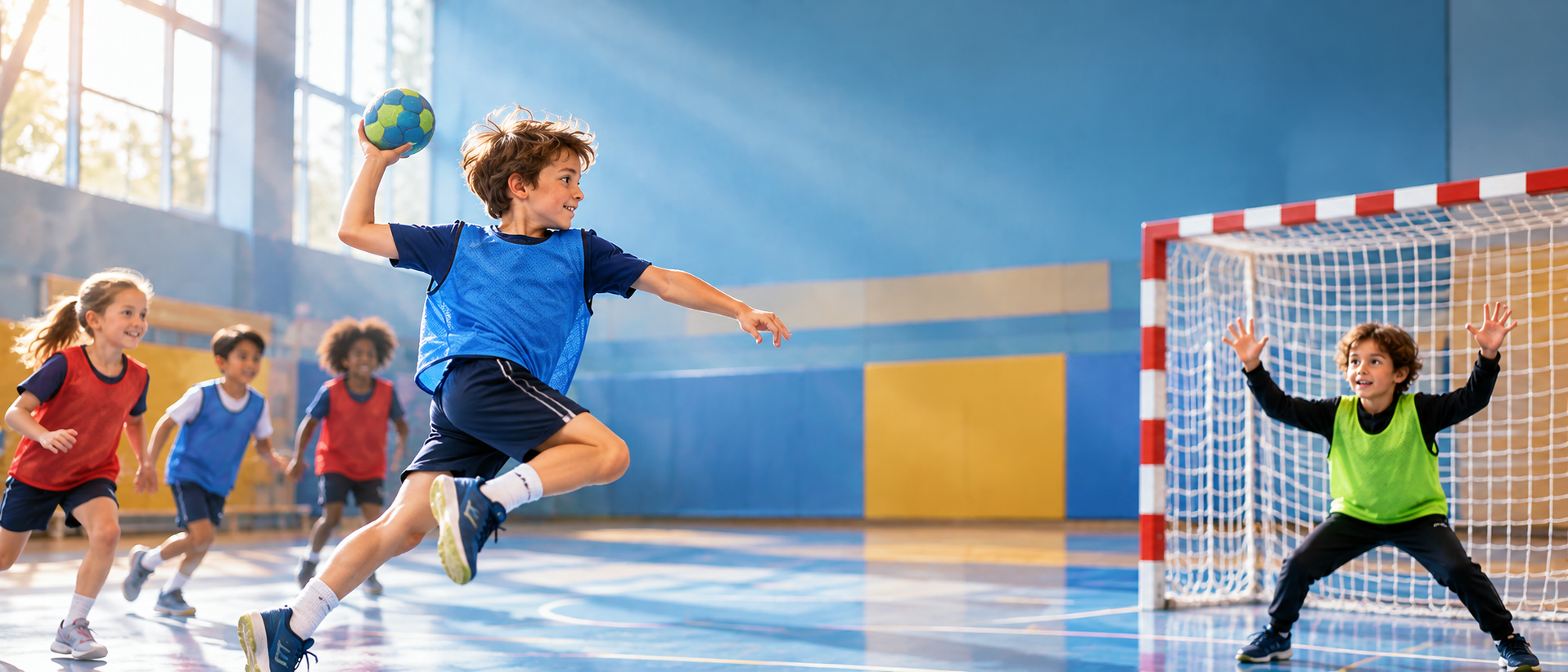
Handball is one of the fastest, most dynamic team sports in the world. For young players, the journey from mini handball to full handball is an exciting pathway filled with fun, skill development, and personal growth. This article explores the key developmental training pathways, age-appropriate progressions, and practical coaching tips that help children smoothly transition from small-sided introductory games to the full-size handball court.
Whether you are a coach, parent, PE teacher, or club organizer, understanding how to structure training and competition at each stage is essential for long-term athlete development and for keeping children motivated and injury-free.
What Is Mini Handball?
Mini handball is a simplified version of traditional handball designed for children, usually under 11-12 years old. It uses smaller courts, lighter balls, modified rules and playful formats to introduce kids to the essentials of the game in a safe, engaging way.
Typical Characteristics of Mini Handball
- Reduced court size
- Smaller, lighter balls
- Shorter playing time and more frequent substitutions
- Fewer players on the court (3v3, 4v4, or 5v5)
- Less contact and simplified rules (e.g., minimal dribbling rules, no or limited blocking)
- Emphasis on fun, participation and basic skills over competition
The main objective of mini handball is to develop a love for the sport while fostering fundamental movement skills such as running, jumping, throwing and catching.
From Mini to Full Handball: Why a Developmental Pathway Matters
Rushing children into full handball too early can lead to frustration, injuries and dropout. A structured developmental training pathway in handball ensures that each player experiences:
- Age-appropriate physical loads
- Gradual tactical and technical progression
- Positive psychological development and self-confidence
- Long-term motivation to stay in the sport
By building training stages step-by-step, coaches help young players develop a solid foundation in technique, game understanding and teamwork that prepares them for the demands of full-size competitive handball.
Key Stages of Handball Development
While exact age ranges differ between countries and clubs, most handball development programs move through similar stages. The table below summarizes a typical progression.
| Stage | Approx. Age | Main Focus | Game Format |
|---|---|---|---|
| Intro / Mini Handball | 6-9 | Fun, basics, coordination | 3v3 / 4v4 |
| Transition Stage | 9-12 | Technical skills, basic tactics | 4v4 / 5v5 / reduced court |
| Pre-Youth / Youth | 12-15 | Position roles, physical development | 6v6, near full rules |
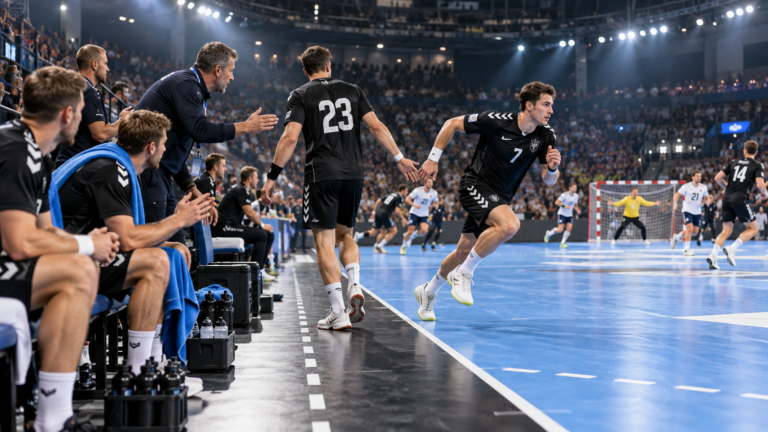
| Full Handball | 15+ | Advanced tactics, competition | 6v6, full court |
Core Building Blocks for Progression
A successful transition from mini to full handball is not just about changing court size or adding players. It requires structured work in four core areas:
- Technical skills
- Tactical understanding
- Physical development
- Mental and social skills
1. Technical Skills: From Basic to Advanced
Foundational technical skills are first introduced in mini handball and then refined as players near full handball.
- Ball handling: catching, passing (chest, bounce, overhead), one-handed control
- Shooting: standing shots, jump shots, running shots, penalty throws
- Footwork: steps, stops, pivots, basic feints
- Dribbling: controlled dribbling, using dribble to create space, not as the main option
- Goalkeeping basics: stance, movement, reaction, safe diving techniques
As players grow, drills become faster, more complex and more game-like. Technical training always needs to remain highly repetitive, but never boring – variety, competition and fun challenges are vital.
2. Tactical Development: Reading the Game
Early tactical learning begins in mini handball and evolves into full offensive and defensive systems in full handball.
Mini Handball Tactical Goals
- Understanding simple space awareness: where to move, where to pass
- Basic 1v1 situations in attack and defense
- Simple give-and-go combinations
- Introduction to teamwork: looking for free teammates, staying spread out
Transition to Full Handball Tactics
- Learning structured attacking patterns (e.g., crossing, screening)
- Zone defenses such as 3:3, 5:1 and 6:0
- Fast breaks and second-wave attacks
- Position-specific roles (wing, back, pivot, center-back, goalkeeper)
Video analysis, tactical whiteboards and small-sided games are powerful tools for developing tactical intelligence in youth handball.
3. Physical Development and Injury Prevention
Children are not mini adults. Training loads must be adapted to their growth and maturation. A well-designed handball conditioning program for youth should include:
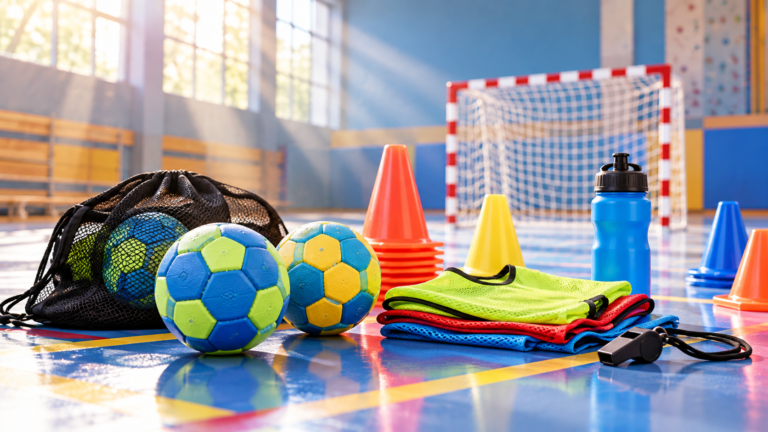
- General coordination: ladders, cones, agility games
- Speed and agility: short sprints, change of direction drills
- Strength: bodyweight exercises (squats, lunges, push-ups, core)
- Mobility: dynamic stretching, joint control
- Injury prevention: shoulder and knee stability exercises (e.g., balance boards, elastic bands)
Before puberty, the focus is on movement variety and good technique. After puberty, training can include more structured strength and endurance components to support the demands of full handball.
4. Mental and Social Skills
The psychological side of handball is often overlooked, yet it is central to successful progression from mini to full handball:
- Building confidence through achievable challenges
- Developing resilience by normalizing mistakes and learning from them
- Encouraging communication and leadership in training and games
- Fostering a growth mindset and love of learning
Coaches and parents should focus more on effort, teamwork and improvement than on winning at early ages.
Age-by-Age Training Pathways
Stage 1: 6-9 Years – Discovering Mini Handball
This is the “golden age” of play. The goal is to make children fall in love with movement and the ball.
- Main objectives: fun, basic coordination, simple rules
- Game formats: 3v3 or 4v4 on small courts, no fixed positions
- Time with the ball: everyone touches the ball frequently
- Contact: very limited, focus on safe play and fair play
Typical exercises include tag games with a ball, relay races, simple passing circles, basic shooting at mini goals and 1v1 duels in controlled settings.
Stage 2: 9-12 Years – Transition Toward Full Handball
Children are ready to handle more structure and technique, but still need plenty of game variety.
- Main objectives: refine basic skills, introduce simple tactics, improve movement quality
- Game formats: 4v4, 5v5, gradually larger courts
- Positions: rotational – players try out different roles (wing, back, pivot)
- Rules: step-by-step introduction of standard handball rules (steps, dribbling, free-throws)
This stage is crucial for building a robust technical base. Players learn correct throwing mechanics, safe landings from jumps and basic offensive and defensive concepts.
Stage 3: 12-15 Years – Pre‑Youth and Youth Handball
This is where the game begins to resemble full handball more closely.
- Main objectives: position-specific skills, tactical awareness, physical conditioning
- Game formats: 6v6 on near or full-size court
- Positions: players begin to specialize, but still change roles occasionally to avoid early specialization
- Rules: almost fully aligned with adult handball, with some variations depending on league
Training now includes more demanding drills: small group tactics (2v2, 3v3), structured defensive systems, fast-break organization and basic strength and conditioning sessions.
Stage 4: 15+ Years – Full Handball
At this stage, athletes are playing full handball with adult rules, court size and intensity.
- Main objectives: advanced tactics, peak physical performance, competition
- Game formats: 6v6, full court, full rules
- Positions: clear specialization according to individual strengths
- Support training: strength, power, speed, recovery and injury prevention fully integrated
Players may participate in regional or national competitions, and training loads are carefully monitored to balance school, sport and recovery.
Benefits of a Structured Developmental Pathway
A well-planned progression from mini to full handball offers multiple benefits for young athletes and clubs alike.
- Better skill acquisition: children master fundamentals before facing complex game situations.
- Reduced injury risk: physical demands align with growth and maturation.
- Higher retention: kids stay in the sport longer when the experience is positive and age-appropriate.
- Stronger teams: clubs build generations of technically and tactically sound players.
- Holistic development: social, emotional and cognitive abilities grow alongside sporting skills.
Practical Coaching Tips for Each Stage
Tips for Mini Handball Coaches (6-9)
- Use short, varied activities (5-10 minutes) to match attention spans.
- Replace lines and waiting with stations and small groups.
- Give simple, clear instructions and demonstrate visually.
- Celebrate effort and creativity, not just goals or wins.
- Focus on general movement skills, not early specialization.
Tips for Transition Stage Coaches (9-12)
- Combine technical repetition with game-like drills.
- Teach simple game principles: keep width, create depth, support the ball carrier.
- Keep physical training playful: obstacle courses, speed games, partner challenges.
- Rotate players through positions to broaden their understanding of the game.
Tips for Youth Handball Coaches (12-15+)
- Introduce clear role expectations while allowing some position flexibility.
- Use video feedback to improve decision-making and tactical understanding.
- Plan training cycles (microcycles and mesocycles) to manage fatigue and peak for key matches.
- Include regular injury-prevention blocks for shoulders, knees and ankles.
- Communicate openly about goals, pressure and balance with school or work.
Sample Weekly Training Structure
The table below shows an example of how training frequency and focus might evolve across the development pathway.
| Age Group | Sessions / Week | Approx. Duration | Main Focus |
|---|---|---|---|
| 6-9 (Mini) | 1-2 | 60 min | Fun, basics, play |
| 9-12 (Transition) | 2-3 | 75 min | Technique, simple tactics |
| 12-15 (Youth) | 3-4 | 90 min | Tactics, conditioning |
| 15+ (Full) | 4-6 | 90-120 min | High performance |
These numbers are illustrative; actual plans should be individualized and coordinated with school and other activities.
Real-World Example: A Club’s Pathway from Mini to Full Handball
Consider a mid-sized community club that wants to develop a strong internal pathway:
- Mini Handball Academy (U8-U10): One or two fun-focused sessions per week, festival-style tournaments with multiple short games and mixed teams.
- Development Teams (U11-U13): Regular league play with modified rules, structured training including technical blocks and simple team tactics.
- Youth Squads (U14-U16): Introduction of position-specific coaching, participation in regional leagues, progressive conditioning program.
- Junior / Senior Teams (U17+): Full handball participation, integrated strength and conditioning, video analysis, and performance goals.
By coordinating philosophy, terminology and drills across all age groups, the club ensures that every player knows what to expect as they move up, and coaches can build on previous stages instead of starting from scratch.
How Parents Can Support the Progression
Parents play a crucial role in helping children transition from mini to full handball smoothly.
- Encourage multi-sport participation in the early years for broader motor development.
- Value effort and enjoyment over results and rankings.
- Ensure adequate sleep, nutrition and recovery, especially during growth spurts.
- Communicate openly with coaches about any pain, injuries or stress.
- Promote independence – let children take responsibility for their gear and punctuality.
SEO-Friendly Takeaways: Building a Complete Handball Player
To summarize the most important points about progressing from mini to full handball and creating effective developmental training pathways:
- Start with mini handball to build fundamental movement and basic ball skills in a playful environment.
- Use age-appropriate training plans that progressively develop technical, tactical, physical and mental abilities.
- Gradually increase game complexity, court size and number of players as children mature.
- Integrate injury-prevention and conditioning elements early to support long-term development.
- Collaborate: coaches, parents and clubs must work together to keep the pathway player-centered.
Conclusion: Designing a Successful Journey from Mini to Full Handball
The transition from mini handball to full handball is not a single step; it is a carefully planned journey. When training is designed around the child rather than the competition calendar, young athletes gain the confidence, skill and love for the game that will keep them involved for years.
By following structured developmental training pathways, coaches and clubs can create environments where every player – from the smallest beginner to the aspiring elite athlete – has the chance to grow at an appropriate pace. With thoughtful planning, consistent coaching and supportive parents, the progression from mini to full handball becomes a natural, enjoyable and highly rewarding experience.