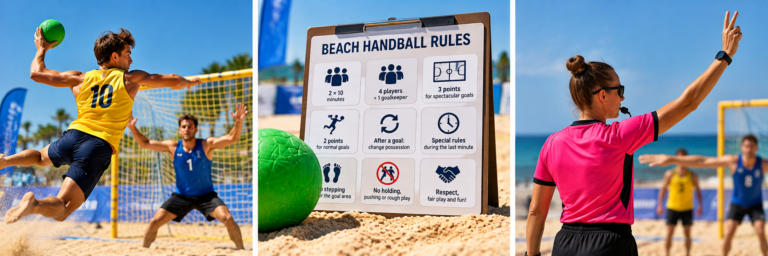

Beach handball is fast, acrobatic, and built for excitement. One of the main reasons fans love this sport is its unique scoring system, where not all goals are worth the same. Understanding the difference between one-point jump shots and two-point spectacular goals is essential for players, coaches, and anyone who wants to truly enjoy watching a beach handball match.
In this guide, we’ll break down how scoring works in beach handball, when shots are worth one or two points, and how teams can use this system strategically. You’ll also find practical tips, examples, and a quick comparison table to help you grasp the main concepts at a glance.
Introduction: Why Scoring Rules Make Beach Handball So Exciting
Unlike traditional indoor handball, beach handball scoring is designed to reward creativity, aerial skill, and tactical risk-taking. Every attack is a chance not only to score, but to score in style.
In most ball sports, every goal counts the same. In beach handball, though, a simple shot might be worth one point, while a spectacular move-such as a 360° spin shot or an alley-oop called a flyer-can earn two points. This encourages players to attempt more spectacular goals, keeps games unpredictable, and gives underdogs real opportunities for comebacks.
If you’re new to the sport or looking to improve your tactical understanding, learning the difference between a basic one-point jump shot and a two-point spectacular goal is the perfect place to start.
Basic Scoring Rules in Beach Handball
Beach handball is played in two sets. Each set is scored separately, and the team that wins two sets wins the match. Within each set, the way points are awarded for goals shapes the entire strategy of the game.
How Many Points Is a Goal Worth?
- 1 point – Regular field player goal (standard shot).
- 2 points – Spectacular or special goal, including:
- Goals scored by the specialist (goalkeeper acting as a field player)
- Spin shots (usually 360° turns in the air)
- Flyer goals (alley-oop type goals)
- Penalty goals (typically 6‑meter throws)
Because of this, not all shots are equal. Teams are constantly weighing the “safe” one-point option against the higher-risk, higher-reward two-point spectacular goal.
What Is a One-Point Jump Shot in Beach Handball?
A one-point jump shot in beach handball is the most basic and common finishing action. It resembles a standard jump shot in indoor handball, but adapted to the sand environment.
Definition of a One-Point Jump Shot
A goal is typically worth one point when:
- It is scored by a regular field player (not the specialist/goalkeeper),
- The shot is executed without a recognized spin (usually 360°) or flyer action,
- It is not a penalty throw, and
- It is not otherwise classified as a spectacular goal under IHF beach handball rules.
The player often jumps from just outside the goal area, releases the ball before landing, and aims for a clean, controlled finish. While it may not be as spectacular as a spin or flyer, it remains an essential tool in any team’s offensive toolbox.
When Teams Choose One-Point Jump Shots
Teams tend to rely on one-point jump shots when:
- The game is tight and they need a highly reliable scoring option.
- They want to build rhythm and confidence early in a set.
- The defense is well organized, making spectacular plays too risky.
- They are in a numerical disadvantage and just want to keep the scoreboard ticking.
Even though they are “only” worth one point, consistent one-point jump shots can win sets, especially if the opponent is failing to convert their riskier two-point attempts.
What Counts as a Two-Point Spectacular Goal?
Two-point spectacular goals are what make beach handball so visually thrilling and unique. They reward creativity, physical ability, and excellent timing between teammates.
Types of Two-Point Goals
| Type of Goal | How It’s Scored | Points |
|---|---|---|
| Spin Shot | 360° turn in the air before releasing the ball | 2 |
| Flyer (Alley-Oop) | Teammate catches and shoots in the air from a pass | 2 |
| Specialist Goal | Goal scored by the specialist/goalkeeper in attack | 2 |
| Penalty (6m Throw) | Goal from a designated penalty throw | 2 |
1. Spin Shots
A spin shot involves the attacker jumping and rotating-typically 360°-before releasing the ball. If the referees recognize the motion as a valid spin, the resulting goal counts for two points.
Key elements of an effective spin shot:
- Good elevation and balance in the sand.
- Full or near-full 360° rotation before release.
- Proper timing to beat the goalkeeper.
- Enough control to keep the shot on target despite moving in the air.
2. Flyer Goals (Alley-Oops)
An alley-oop flyer is one of the most spectacular plays in beach handball. One player passes the ball into the goal area to a teammate who is already in the air. That teammate catches the ball mid-air and shoots before landing.
For a flyer to be awarded two points:
- The receiving player must catch and shoot while airborne.
- The ball must be released before the player lands.
- The move must be clearly a coordinated, airborne action-not a simple catch and shot on the ground.
Flyers demand precision passing, impeccable timing, and mutual trust between players. They are crowd favorites and often momentum-shifting actions.
3. Specialist (Goalkeeper) Goals
In beach handball, the goalkeeper can be replaced by a specially marked field player called the specialist. This player wears a different color shirt and, when in attack, counts as a key offensive weapon.
Any goal scored by the specialist is worth two points, even if it’s a simple shot without spins or aerial acrobatics. This encourages teams to involve their specialist heavily in offense, but it also leaves their own goal empty, making turnovers extremely dangerous.
4. Penalty Goals
Penalty throws (usually from six meters) are awarded following serious infringements or clear goal-scoring chance denials by the defense. In most competitions following IHF rules, a successful penalty goal is worth two points.
Because they are taken under controlled conditions and count for double, penalty conversions are crucial in the final score of each set.
Strategic Comparison: One-Point vs. Two-Point Shots
Teams must constantly decide whether to use safer one-point jump shots or riskier two-point spectacular goals. This decision depends on the match context, skill level, and defensive setup.
Risk-Reward Balance
| Aspect | One-Point Jump Shot | Two-Point Spectacular Goal |
|---|---|---|
| Difficulty | Lower | Higher |
| Scoring Value | 1 point | 2 points |
| Risk of Turnover | Moderate | High (misses often lead to fast breaks) |
| Best Use Case | Maintaining lead; stabilizing attack | Chasing the score; exploiting momentum |
When to Prioritize One-Point Jump Shots
- Protecting a lead: With a small advantage late in a set, stable one-point jumps can close out the game safely.
- Breaking a bad streak: If the team has missed multiple two-point attempts, a few simple goals can restore confidence.
- Facing strong defense: When spin shots and flyers are well-covered, straightforward jumps become more efficient.
When to Chase Two-Point Goals
- Trailing on the scoreboard: Two-point plays help close gaps quickly, especially in the final minutes of a set.
- Taking advantage of mismatches: If your team is more technical or physically dominant, spectacular goals maximize your edge.
- Building momentum: A successful flyer can energize the entire team and put psychological pressure on opponents.
Benefits of Spectacular Two-Point Goals for Teams
Beyond the scoreboard, two-point goals provide several strategic and psychological benefits.
1. Psychological Impact
- A well-executed spin or flyer often lifts team morale and creates a surge of energy.
- The defending team may feel discouraged, especially after conceding multiple two-point plays in quick succession.
- Fans react strongly to spectacular goals, which can turn the crowd into an extra ally.
2. Tactical Flexibility
- Having reliable two-point scorers forces opponents to adapt their defensive systems.
- Defenses may commit extra players to stopping the specialist or the primary flyer receiver, opening spaces for simple one-point jump shots.
- The constant threat of two-point actions increases the uncertainty in the opponent’s tactical planning.
3. Player Development
- Training for spin shots and flyers improves coordination, timing, and athleticism.
- Players develop better spatial awareness and creativity.
- Young athletes stay engaged and motivated thanks to the “fun” element of spectacular goals.
Practical Tips for Players: Improving Beach Handball Scoring
Tips for Better One-Point Jump Shots
- Work on your approach: Practice stable, controlled steps on sand to avoid slipping before the take-off.
- Focus on release height: Aim to release the ball from the highest possible point to reduce the goalkeeper’s angle.
- Use quick wrist action: A fast wrist snap increases shot speed without sacrificing control.
- Vary shot placement: Alternate between corners, low shots, and bounce shots to stay unpredictable.
Tips for Two-Point Spin Shots
- Start slowly: Practice 180° spins on flat ground before attempting full 360° rotations in the sand.
- Balance first, power second: It’s better to execute a slower, controlled spin that hits the target than a wild, off-balance attempt.
- Use visual cues: Try to spot the goalkeeper’s position briefly during the rotation and adjust your shot accordingly.
- Drill repetition: Repeating the motion builds muscle memory and reduces fear of mid-air contact or loss of orientation.
Tips for Flyer (Alley-Oop) Goals
- Establish clear roles: Decide in advance who will typically be the passer and who will be the finisher.
- Train timing: Practice run-in routes and jump timing without defenders before introducing opposition.
- Communicate: Simple calls, hand signals, or eye contact can trigger the flyer play.
- Use simple passes: A precise, slightly lofted pass is better than a hard, difficult ball that is hard to catch mid-air.
Using the Specialist Effectively
- Quick substitutions: Perfect the transition when the goalkeeper comes out and the specialist joins the attack.
- Safe passing: Turnovers with an empty goal are costly; prioritize secure passes when the specialist is on court.
- Positioning: The specialist should find spaces at the 6-7 meter zone, ready to finish from good angles.
- Shot selection: Remember that even a “simple” specialist shot is worth two points, so it can be better than a high-risk spin from someone else.
Case Example: Turning a Set Around with Two-Point Goals
Imagine a team trailing 12-16 late in the first set. Relying only on one-point jump shots, they would need to outscore the opponent by at least four goals to catch up. However, by tactically introducing more two-point spectacular goals, the situation changes completely.
Scenario:
- The trailing team switches to an offensive system using a specialist.
- They score a spin shot (2 points) and a specialist goal (2 points), while conceding just one one-point goal.
In just a few attacks, the score might shift from 12-16 to 16-17, and with another successful two-point flyer, they can even take the lead. This illustrates how important it is to master the different scoring options in beach handball and use them at the right time.
Common Mistakes in Beach Handball Scoring Attempts
Overusing Two-Point Attempts
- Teams sometimes force spin shots or flyers when a simple one-point jump shot would be smarter.
- This can lead to missed opportunities and dangerous fast breaks for the opponent.
Ignoring Game Context
- Trying risky spectacular goals while leading comfortably can unnecessarily invite a comeback.
- Sticking only to one-point shots when trailing by a large margin may not generate enough scoring power.
Poor Specialist Management
- Slow changes between goalkeeper and specialist leave the team unbalanced during transitions.
- Miscommunication can lead to empty-goal concessions after turnovers.
SEO-Friendly FAQ: Scoring in Beach Handball
How many points is a regular goal in beach handball?
A regular goal by a standard field player without a spin, flyer, or special condition is worth one point.
What is a two-point goal in beach handball?
A two-point goal in beach handball includes spin shots, flyer goals, goals scored by the specialist, and usually penalty goals. These are rewarded with double points to encourage creativity and skill.
Is a penalty worth one or two points in beach handball?
In most official competitions following IHF rules, a penalty goal (from the 6-meter line) is worth two points.
Does every jump shot count as a spectacular goal?
No. A jump shot without a recognized 360° spin or flyer action is usually classified as a one-point goal, even if the player leaves the ground.
Conclusion: Mastering the Art of Scoring in Beach Handball
Scoring in beach handball is more than just throwing the ball into the net. It’s a strategic balance between safe one-point jump shots and high-impact two-point spectacular goals. Teams that understand when to use each option-based on the score, time, and opponent-gain a major competitive advantage.
One-point jump shots provide stability, reliability, and control. Two-point goals, through spins, flyers, specialist shots, and penalties, inject energy, surprise, and tactical depth into the game. The most successful beach handball teams are those that can blend both styles, shifting fluidly between risk and safety as the match evolves.
Whether you’re a player working on your shooting technique, a coach developing offensive systems, or a fan looking to deepen your understanding of the game, appreciating the difference between one-point and two-point goals will enrich every beach handball match you watch or play.
Next time you’re on the sand or in the stands, pay attention not just to how many goals are scored, but how they’re scored. That’s where the real beauty of beach handball lies.