Handball is one of the fastest, most dynamic team sports in the world. But if you’ve ever jumped from a school tournament to a local club match – or watched the EHF Champions League or the Olympic Games – you’ve probably noticed something: the rules don’t always feel the same.
This guide breaks down the common rule differences between club, school, and international handball, so players, coaches, and parents can understand what to expect at each level. We’ll look at game duration, ball size, fouls, substitutions, and more, in a clear and SEO-friendly way.
Why Handball Rules Differ Across Levels
While most handball rules are based on the official International Handball Federation (IHF) rulebook, organizers adapt them to match the age, skill, and safety needs of players. That’s why:
- School handball rules tend to be simplified and safety-focused.
- Club handball rules are closer to official rules but may still be adapted locally.
- International handball rules follow the IHF rulebook strictly and are enforced at the highest level.
Understanding these differences helps you prepare better, avoid penalties, and enjoy the game no matter where you play.
Main Rule Differences at a Glance
| Aspect | School | Club | International |
|---|---|---|---|
| Game Duration | Shorter halves, flexible | Varies by age; adults close to full time | 2 × 30 minutes (standard) |
| Ball Size | Smaller, lighter | Age-/gender-based sizes | IHF standard sizes by category |
| Contact Rules | Very restricted, safety-first | Moderate, age-appropriate | Full contact within IHF rules |
| Substitutions | Informal, rolling subs | Rolling subs, bench rules enforced | Strict substitution zone rules |
| Officials | Often 1 referee, teacher/coach | 1-2 referees, table officials | 2 referees + full table & delegates |
| Sanctions | Warnings & free throws | Progressive, but often lenient | Full progressive sanctions enforced |
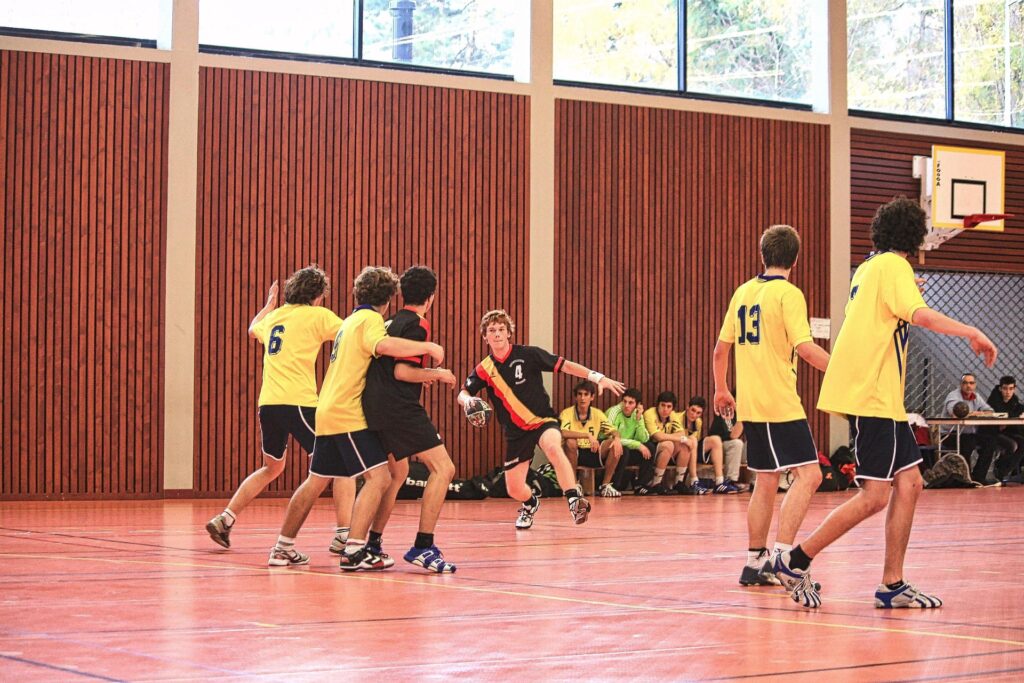
Game Duration and Time Management
School Handball: Shorter Games, Flexible Timing
In school handball, match length is often adjusted to fit lesson plans, festivals, or tournaments:
- Common durations: 2 × 10 or 2 × 15 minutes.
- Sometimes running clock with fewer stoppages.
- Timeouts may be limited or not formally used.
The goal is to keep games short, fun, and inclusive.
Club Handball: Approaching Full Match Length
At the club level, time rules depend heavily on age category:
- U11/U13: often 2 × 15-20 minutes.
- U15/U17: often 2 × 20-25 minutes.
- Seniors: usually the full 2 × 30 minutes as per IHF rules.
Most official club competitions also allow 3 team timeouts (usually one per half and one additional, depending on federation regulations).
International Handball: Strict and Standardized
In international handball competitions like the World Championships or Olympics, time rules strictly follow the IHF rulebook:
- 2 × 30 minutes, with a 10-15 minute halftime break.
- Each team can usually request 3 team timeouts per game (max 2 per half).
- Clock stopped for free throws, penalties, serious injuries, and timeouts.
Ball Size and Equipment Differences
Ball Sizes by Level and Age
Handball ball size significantly affects gameplay, especially for younger players. Here’s a simple comparison.
| Level | Typical Age | Usual Ball Size |
|---|---|---|
| School (Primary) | Under 12 | Size 0-1 (soft, smaller) |
| School (Secondary) | 12-16 | Size 1-2 |
| Club Youth Girls | up to U17 | Size 2 |
| Club Youth Boys | U13-U17 | Size 2-3 |
| Senior Women (Intl.) | 18+ | Size 2 |
| Senior Men (Intl.) | 18+ | Size 3 |
School Handball Equipment
In school environments, balls are often:
- Softer (foam or rubber) for safety.
- Sometimes slightly underinflated for easier catching.
- Goals may be smaller or even improvised (cones, taped areas).
Club and International Equipment
Club and international handball use:
- Standard goals (3m wide × 2m high).
- Regulation balls with properly maintained pressure.
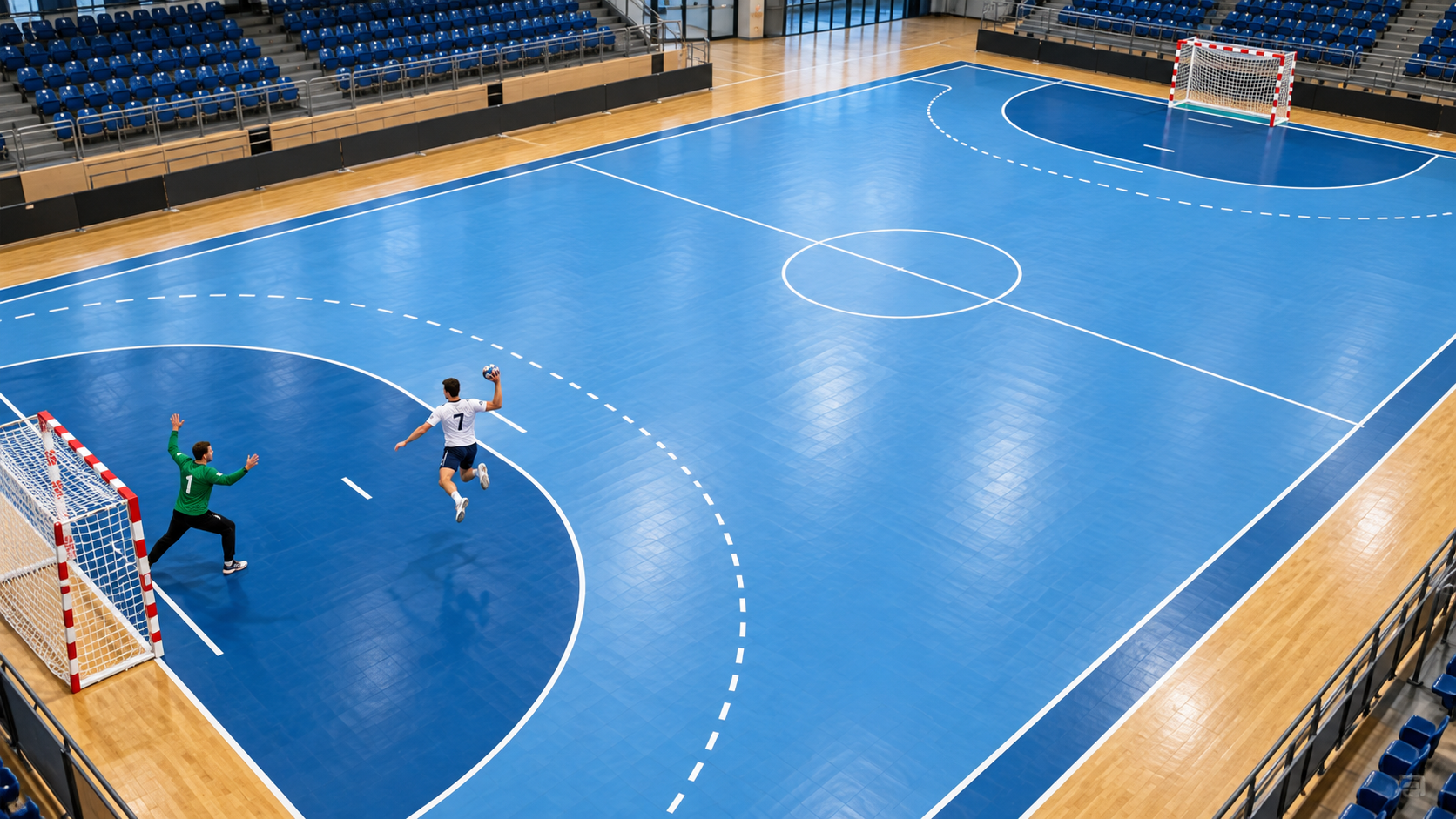
- Floor markings: 6m goal area, 7m throw line, 9m free-throw line, and substitution areas.
In professional or international matches, resin (glue) may be allowed to improve grip, subject to venue and federation rules. In youth and school competitions, resin is often banned for safety and facility maintenance reasons.
Contact Rules and Fouls
School Handball: Minimal Contact
To prioritize safety, school handball rules often limit or forbid physical contact:
- No grabbing, holding, or blocking aggressively.
- Defenders are encouraged to shadow and intercept rather than tackle.
- Referees (often teachers) quickly whistle for free throws instead of issuing cards.
This helps beginners learn positioning and passing before full-contact defending.
Club Handball: Controlled Physicality
In club handball, especially from U15 upwards, full contact within the rules is allowed:
- Defenders can use their body, arms bent, to block or slow attackers.
- Holding around the torso with control (not violently) is generally accepted.
- Hard or dangerous fouls can lead to 2-minute suspensions or red cards.
However, local federations often emphasize player safety and may penalize rough play more strictly in youth categories.
International Handball: Full Enforcement of IHF Rules
At the international level, the contact rules are the same as club rules but enforced with greater precision and consistency:
- Any hit to the head, neck, or from behind is likely to be sanctioned severely.
- Progressive punishment (warning → 2 minutes → disqualification) is consistently applied.
- Video replay may be used in some competitions for serious incidents.
Substitutions and Bench Rules
School Handball: Flexible and Informal
In school handball, substitutions are usually:
- Rolling subs at almost any time, often without a marked substitution line.
- Coach- or teacher-managed, sometimes during natural breaks in play.
- More focused on giving everyone playing time than on strict rule enforcement.
Club Handball: Organized Rolling Substitutions
Club competitions use standard rolling substitutions in a marked substitution area:
- Player leaving must be fully off the court before the substitute enters.
- Illegal substitution can result in 2-minute suspensions.
- Coaches may use substitutions strategically for defense-offense changes.
International Handball: Strict Substitution Protocol
At the international level:
- Substitution area rules are monitored closely by referees and table officials.
- Illegal entry or too many players on court is punished immediately.
- Tactical changes (e.g., 7 vs 6 attack with an extra field player) are used frequently and require perfect timing.
Sanctions: Warnings, Suspensions, and Cards
School Level: Education Over Punishment
In many school handball tournaments, referees focus on teaching:
- More verbal warnings, fewer formal yellow cards.
- Short suspensions may be replaced by substitutions or simple explanations.
- Disqualifications (red cards) are rare and usually reserved for very unsafe behavior.
Club Level: Progressive Sanctions
Club handball follows the classic progressive punishment model:
- Yellow card – warning.
- 2-minute suspension – team plays shorthanded.
- Red card – disqualification for the rest of the match.
- In some severe cases, a report may follow, leading to suspension from future games.
International Level: Zero Tolerance for Dangerous Play
At international events, referees are trained to be especially strict with:
- Fouls on jumping shooters.
- Hits to the head/neck or from behind.
- Unsportsmanlike behavior (e.g., protests, simulation, delaying the game).
The same color-card system applies, but with greater consistency and often with video analysis support.
Referees, Officials, and Match Organization
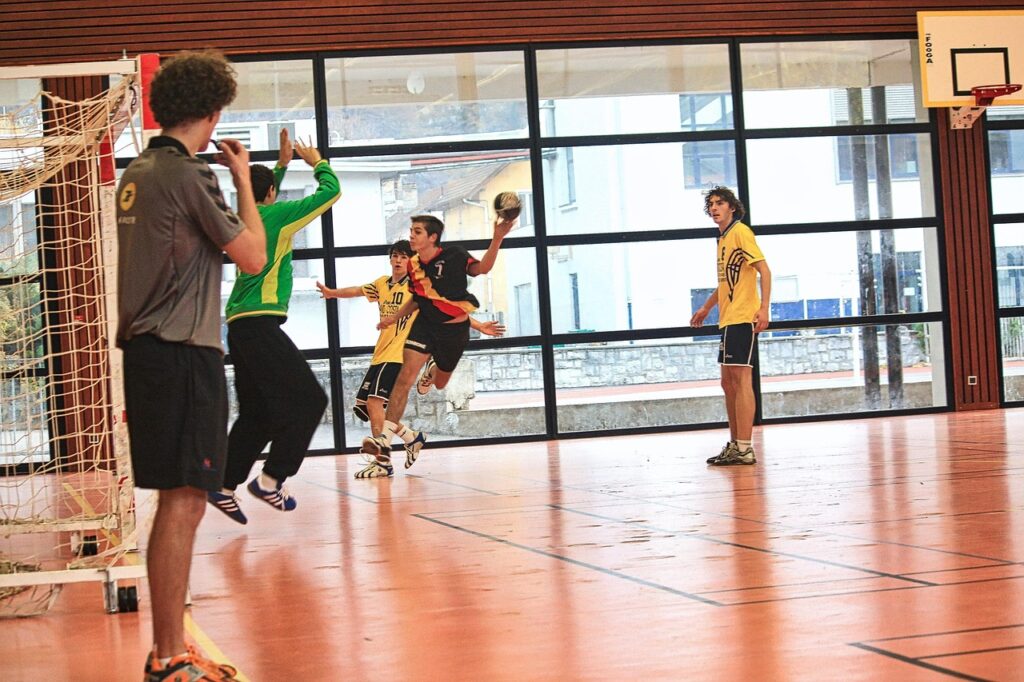
School Handball Organization
School matches are usually overseen by:
- Physical education teachers.
- Student referees in interschool events.
- Minimal table staff (scorekeeper, maybe a timekeeper).
Rules can be adapted on the spot to keep games fair and enjoyable.
Club Level: More Formal Structure
Club matches typically include:
- One or two certified referees.
- A table with a timekeeper and scorekeeper.
- Competition rules provided by the national or regional federation.
International Level: Full Professional Setup
International handball matches are highly structured:
- Two referees working as a team (court and goal referees).
- Technical delegates supervising rule application.
- Timekeeper, scorekeeper, statisticians, and sometimes instant replay officials.
Case Example: One Player, Three Competitions
Consider a 16-year-old player named Alex who plays handball in three different environments:
- At school, Alex plays in a short 2 × 15 minute game. Contact is limited, the teacher allows free substitutions, and most fouls are called quickly with just a free throw. The focus is participation and fun.
- At the club, Alex plays 2 × 25 minutes under regional federation rules. The coach makes tactical substitutions, contact is harder, and Alex needs to understand when a foul could lead to a 2-minute suspension.
- In a youth national team camp, Alex plays 2 × 30 minutes. Every detail counts: shot timing, defensive contact, and substitutions in the correct zone. Mistakes can cost the team dearly.
Same sport, three experiences – all shaped by rule differences between school, club, and international handball.
Practical Tips for Players and Coaches
For Players
- Ask about local rules before each competition: game length, contact, timeouts, and substitutions.
- Adjust your physicality to the level – what’s acceptable in club might be too rough for a school game.
- Practice with the ball size you’ll use in matches to improve control and shooting accuracy.
For Coaches and PE Teachers
- Use simplified rules in school to introduce handball fundamentals safely.
- Gradually integrate full-contact rules at the club as players grow older and more experienced.
- Teach the spirit of the rules – fair play, respect, and safety – not just the letter of the law.
- Prepare advanced players by explaining international variations, such as stricter sanctions or time management.
Benefits of Understanding Rule Differences
Knowing the differences between school, club, and international handball rules offers several advantages:
- Better performance – Players can adjust tactics and intensity to match the competition level.
- Improved safety – Understanding acceptable contact reduces injuries and unnecessary fouls.
- Smoother transitions – Moving from school to club, or from club to international play, becomes less stressful.
- More enjoyment – Fewer surprises and arguments over rules mean more time enjoying the game.
Conclusion: One Sport, Many Faces
Handball may look slightly different in a school gym, a local club arena, or an international championship venue, but at its core, it’s the same fast-paced, team-centered sport. The key differences lie in:
- Game duration and time management.
- Ball size and equipment.
- Contact rules and physical intensity.
- Substitution systems and bench regulations.
- Sanctioning and referee strictness.
By understanding these common rule differences between club, school, and international handball, players, coaches, and parents can navigate the sport more confidently. Whether you’re just learning the basics in PE class or dreaming of playing on the international stage, adapting to the rules of each level is an essential part of your handball journey.